Guwahati is the great city of the lower Brahmaputra. It is the oldest urban place in the region by a wide margin. It is strung along both banks of the river, at the point where it narrows between low hills. It has worn many roles across its long life. It was the Pragjyotishpura of legend and the capital of ancient Kamarupa. It was the religious capital of the goddess on the Nilachal hill. It was the river-gate that the empires of the plains and the Ahoms fought to hold. And in the last century it became the crowded metropolis that is now the effective capital of the whole northeast. To understand Guwahati is to read all of those cities at once, laid one over another along the same few miles of riverbank.
Pragjyotishpura, the city of eastern light
In the oldest layer of memory the city is Pragjyotishpura. The tradition reads the name as the place of eastern light, or of astrology. The epics make it the capital of the demon-king Naraka, and after him of his son Bhagadatta. Bhagadatta is said to have led an army of the east to the great war of the Mahabharata. Beneath the legend lies a real and very old kingship. From at least the fourth century the city was a seat of the kings of Kamarupa. That line ruled the Brahmaputra valley for some six centuries. It left the copper-plate grants on which the early history of the region is built. Its greatest king, Bhaskaravarman, received the Chinese pilgrim Xuanzang at his court in the seventh century, and allied with the emperor Harsha of Kanauj. It is from his reign that we have the clearest picture of Pragjyotishpura as a true capital. It was a centre of learning, ritual and power at the eastern edge of the Indian world. The pilgrim's stay at the court is told in full as a story.
There is a long contest over what to call this land. The names Pragjyotisha, Kamarupa and Assam each mark an age. That contest runs through the whole of the city's story.
The hill of the goddess
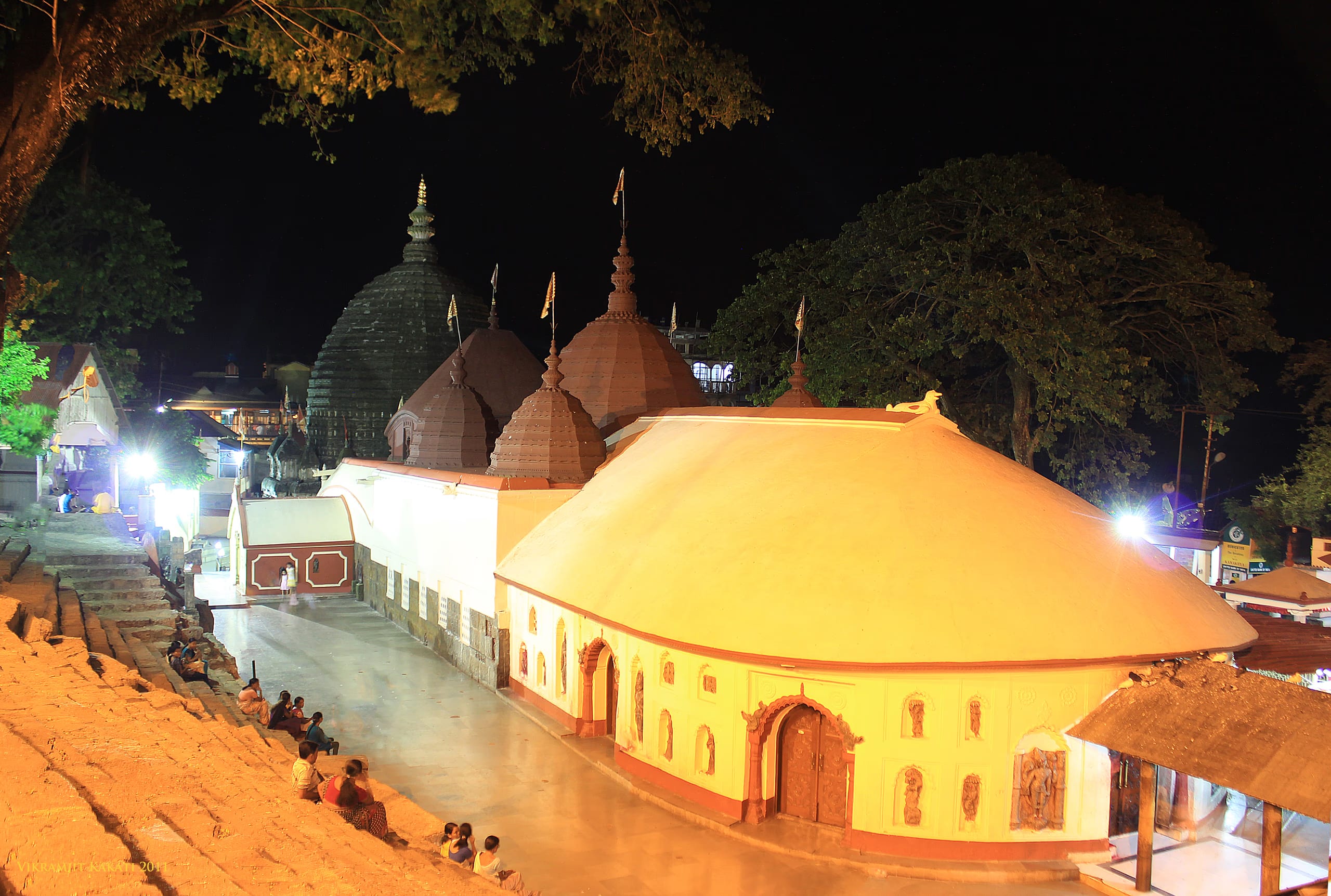
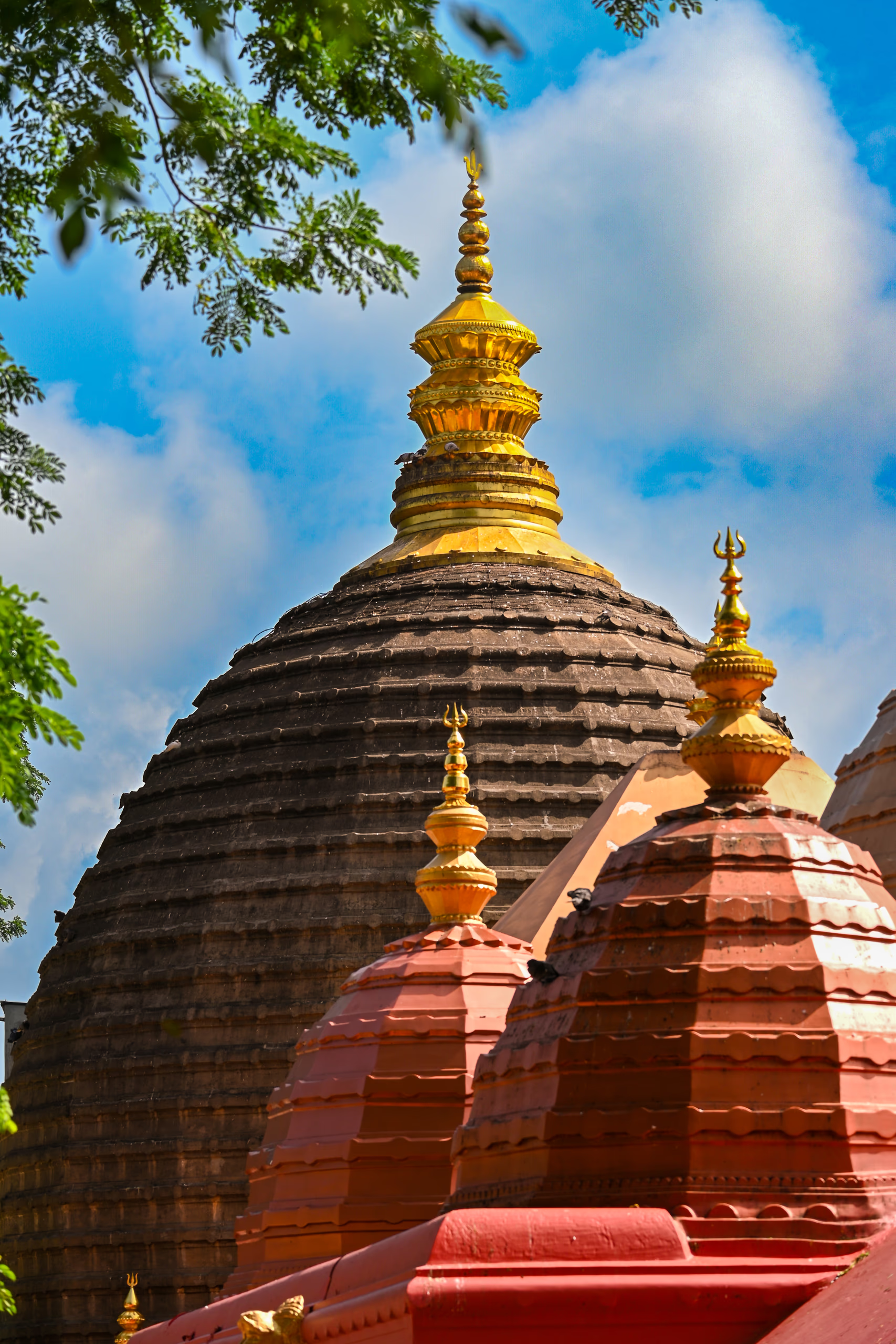
What made Pragjyotishpura more than a fortress on a river was the hill that rises above it. The Nilachal hill carries the shrine of Kamakhya, the most important seat of the Shakta worship of the goddess in eastern India. Since deep antiquity the city has been, first and foremost, a religious capital. It was a place of pilgrimage and of the tantric learning that gathered around the goddess. The temple has its own long story, told on its own page. Here it is enough to say that the cult of Kamakhya gave Guwahati a sanctity that outlasted every dynasty that held the city. A ring of older shrines grew up along the riverbank in the gravitational field of that one great hill. They were raised to Shiva, the planets and the river itself. The myth of how the city came by its first king, and by the goddess on the hill, is the subject of the second story below.
The river-gate the empires fought for
Sanctity was never the city’s only value. Where the Brahmaputra pinches between the hills, Guwahati was also the lock on the whole valley.
Guwahati’s position commanded the narrows of the Brahmaputra. This made it the strategic key to the whole valley. Through the medieval centuries it was fought over again and again. It was the frontier between the powers of the west and the rising Ahom kingdom of the east. Those western powers were the Koch, and then the Mughals. The Mughals took the city more than once and were thrown out again. The long struggle reached its climax in 1671 at Saraighat, on the river just west of the city. There the dying Ahom general Lachit Borphukan broke a larger Mughal expedition. The battle was fought in the narrows between the island of Umananda and the north-bank shrine of Aswaklanta, and it kept Assam out of the empire for good. After Saraighat the city was governed for the Ahoms by the Borphukan, the viceroy of lower Assam, from his seat here. It remained the western military capital of the kingdom until the upheavals of the Ahoms’ last years.
The Night of SaraighatA dying general, a wavering fleet, and the river that kept Assam free of the Mughals.Read the story →From colonial town to capital of the northeast
The river that the empires had fought to hold became, in time, the artery of a new economy. The same narrows that carried fleets now carried trade and a bridge.
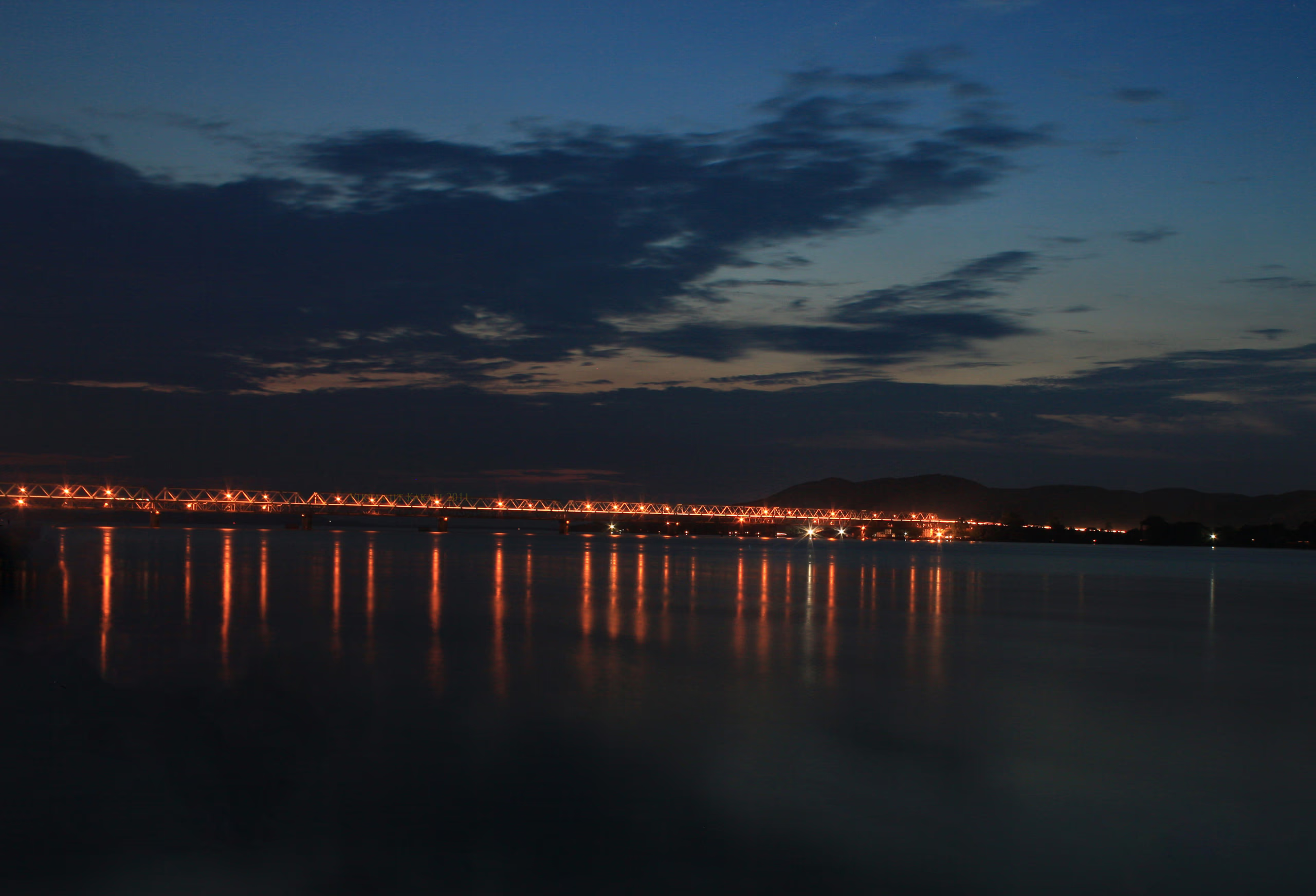
Under British rule the old religious and military town was remade as a commercial one. Guwahati became the river-port and trading centre through which the tea, timber and oil of the province moved. It was the head of steam navigation on the Brahmaputra and a junction of the new railways. Around that commerce grew the institutions of a colonial provincial town, the schools, the press and the offices. After independence the city’s rise accelerated beyond all its earlier roles. The seat of government shifted to the new capital complex at Dispur on its southern edge. Road, rail and air made it the gateway to the entire region. Guwahati spread up the hills and along both banks into the sprawling, congested metropolis it is today. It is by far the largest city of the northeast, and the commercial, educational and cultural hub on which the modern life of Assam turns. The ancient sanctity has not gone. It has simply been overgrown. The pilgrim crowds still climb the Nilachal hill above a city of a million people.
The temples and sights of the city
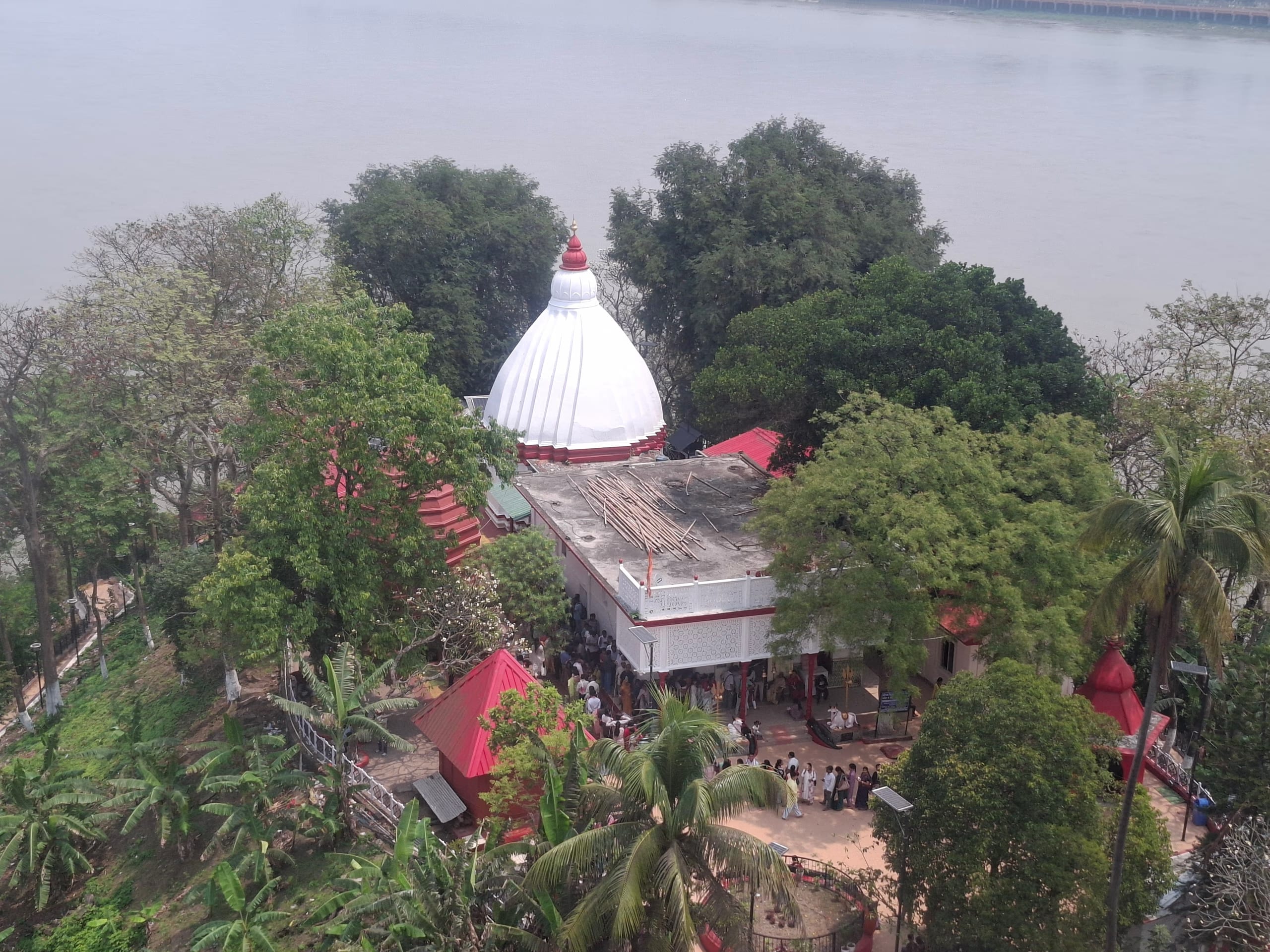
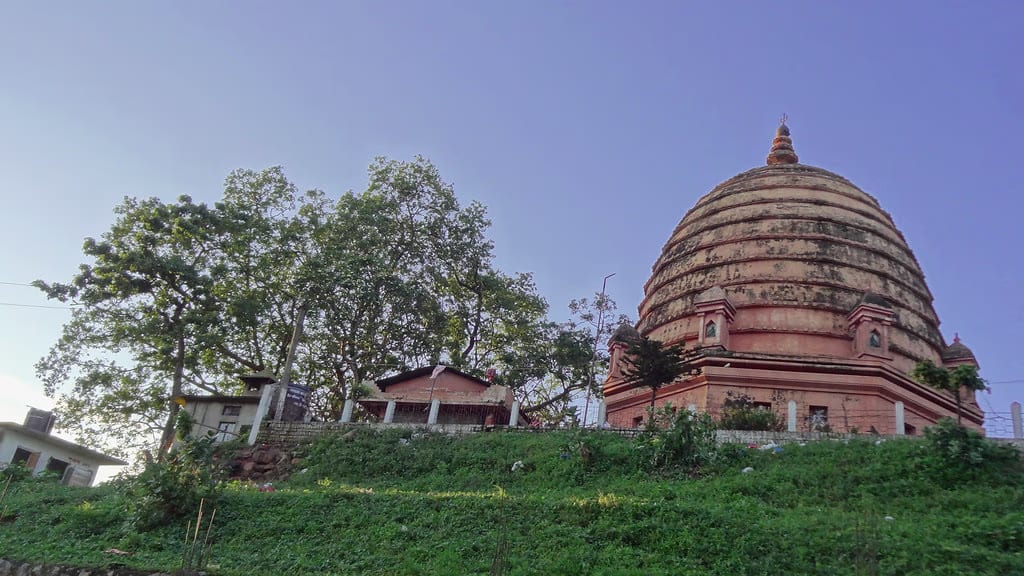
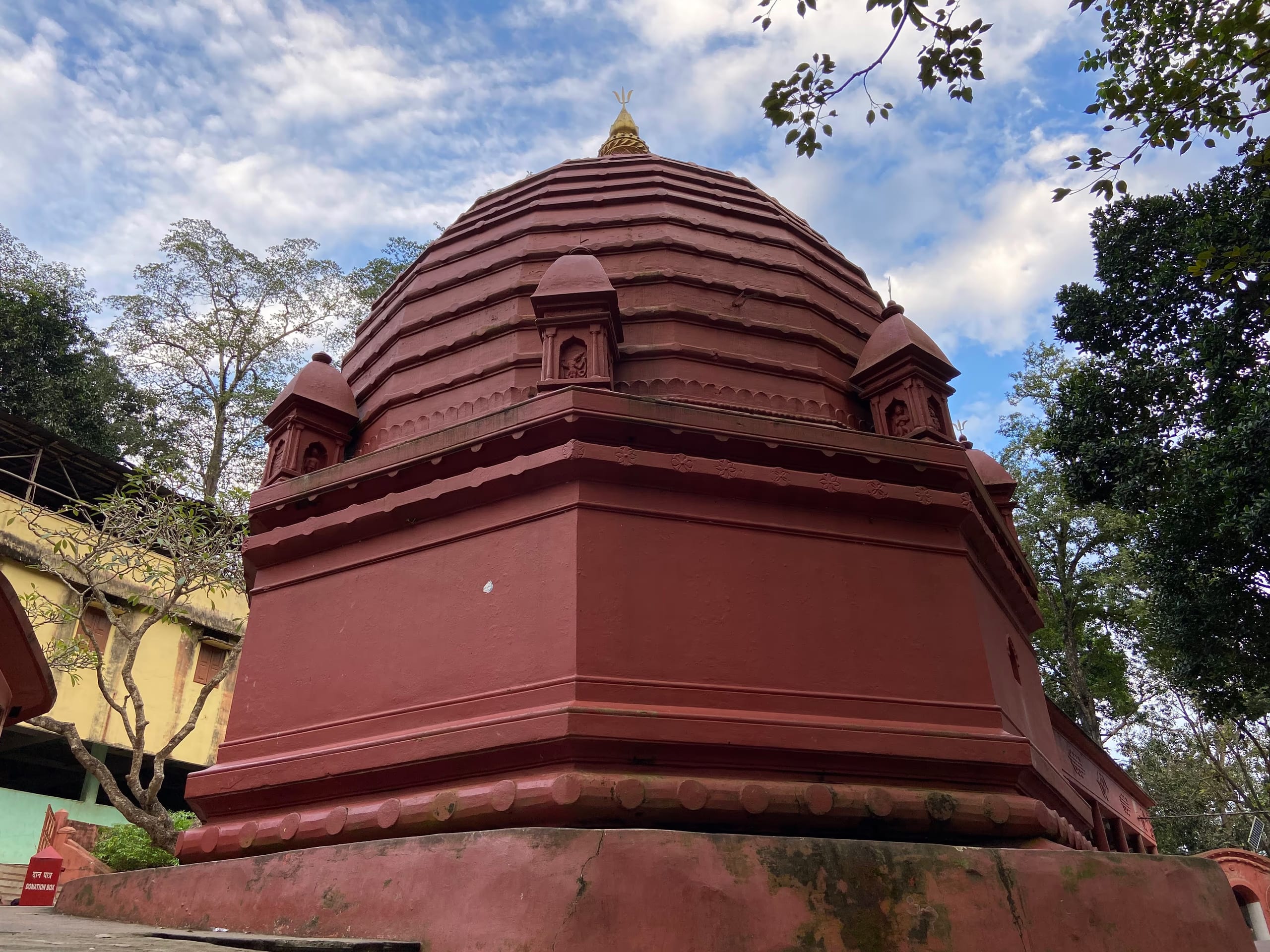
For all its modern sprawl, Guwahati is best read through the ring of ancient shrines that the river and the goddess drew around themselves. Above the city stands Kamakhya on its hill, the heart of the whole place. In the river below sits the little island temple of Umananda, reached by ferry. On the banks stand the Shiva shrines of Sukreswar and the unusual Navagraha, the temple of the nine planets. The Navagraha recalls the city’s old name and its repute for astronomy. A little out of the centre lie the hot springs and hermitage of Basistha. Across the water on the north bank are the older, quieter shrines of Aswaklanta, Doul Govinda, Dirgheswari and Manikarneswar. Several of them stand on hills with long views back over the river to the city. Taken together they make Guwahati not a single monument but a sacred landscape. Its true plan is the scatter of shrines along the Brahmaputra and the great hill that presides over them all.
The green frame of the city
For all its growth, Guwahati is still set in a remarkable frame of water and forest. The contest between the spreading city and that frame is one of the defining stories of the modern town. On its south-western edge lies Deepor Beel, the last great freshwater wetland of the city. It is a Ramsar site and a wintering ground for thousands of migratory birds. Across it an old elephant corridor still runs down from the southern hills to the river. Those hills, the forested ridges that ring the city, are themselves wild. The sanctuary of Amchang on the eastern side and the reserve forest of Garbhanga to the south still hold elephants, leopards and hornbills within an hour of the centre. So the capital sits, almost uniquely among Indian cities, with real jungle and a Ramsar wetland against its built edge. A million people now press on that frame. Encroachment, the railway and the refuse crowd Deepor Beel, and roads cut the elephant paths. This is the central environmental drama of the modern city, and the reason Guwahati’s wild surrounds are watched as closely as its shrines. The birds that gather on the beel each winter belong to the same great river migration told in the story below.
Visiting
Guwahati is the gateway to Assam and the whole northeast. It has the region’s main airport and railway junction, and almost every visitor passes through it. It rewards a day or two in its own right: a morning at Kamakhya, an afternoon ferry to the island temple of Umananda, the river-bank shrines at sunset, and a crossing to the quieter north bank. The cool, dry months from October to March are the most comfortable. The city is also the natural base from which to reach Hajo and Sualkuchi to the west, the wildlife of Pobitora and Kaziranga to the east, and the rest of the valley beyond.