Bhaona is the devotional theatre of Assam. It is the staged performance of the Ankia Naat, the one-act religious plays. Srimanta Sankardev and his disciple Madhavdev composed these plays in the sixteenth century. Their aim was to carry the stories of Krishna and the epics to ordinary people. Bhaona was born in the same neo-Vaishnava movement that produced the Sattriya dance, the Borgeet songs and the mukha masks. It is among the oldest living theatre traditions of India. It predates the modern stage of Bengal and the rest of the east by three centuries.
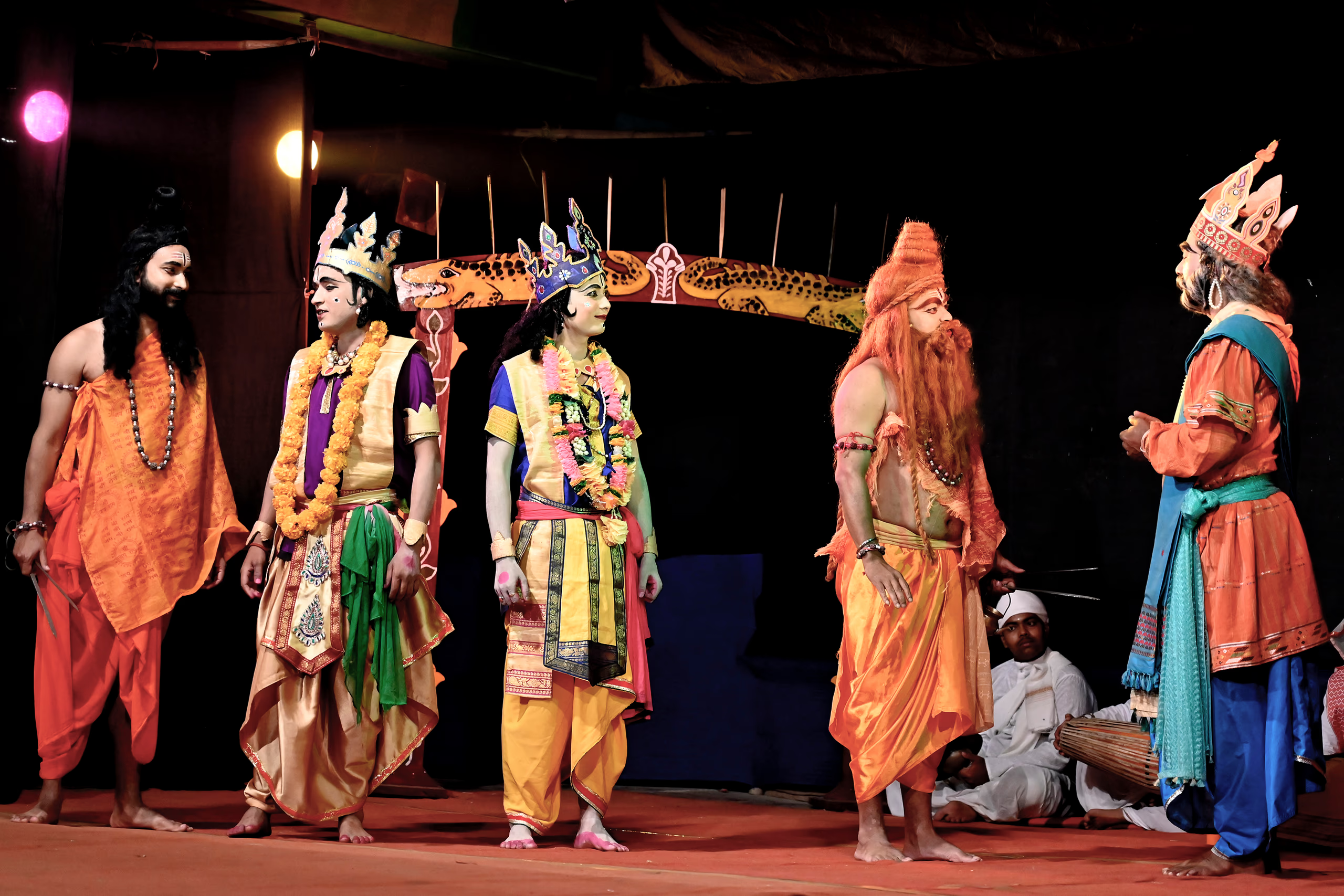
The Ankia Naat
The form is Sankardev's own invention, though it grew from older roots. Before him the valley already knew the Oja-Pali, the narrative song-and-gesture of a lead singer and his chorus. It also knew the putola nach, or puppet theatre. Sankardev had seen play-acting too, on his long pilgrimage. From these he made something new. He is said to have begun in 1468 with the Chihna Yatra, a silent spectacle of painted scenes and music. He went on to write a set of one-act plays, the Ankia Naat, dramatising episodes from the life of Krishna and the epics. Works such as the Kaliya Damana, the Patni Prasada, the Rukmini Harana and the Ram Vijay became the core repertoire. Madhavdev added his own shorter plays. These are not loose scripts but a complete devotional theatre. They fuse narrative, song, dance and spectacle in the service of worship. They stand among the earliest dramatic literature in any modern Indian language.
Brajavali, the language of the stage
The Ankia Naat are not written in everyday Assamese. They are written in Brajavali, an artificial literary idiom that blends Assamese with Maithili. It was created specifically for devotional poetry and drama, and it was never a spoken tongue of any one region. Its roots lie in the Maithili verse of Vidyapati and the Vaishnava poets of the east, whose songs of Krishna and Radha travelled widely, and Assamese devotees reshaped that borrowed diction over their own grammar and sound. The result was a hybrid register, grand and singable, that the wider Vaishnava culture of eastern India could share. Srimanta Sankardev used it not only for the plays but for many of the Borgeet songs, and Madhavdev did the same, so that the same elevated speech binds the theatre to the devotional song.
Within a single bhaona the language works on two levels. The sung verse and the formal speeches carry the Brajavali register, lifting the god-figures above ordinary talk. The narrator's linking passages, spoken by the sutradhar, run in plainer Assamese and gloss the action as it goes. That division keeps the whole intelligible to a village congregation while the poetry stays exalted. So the play is at once liturgically grand and popularly accessible, and the choice of tongue is itself part of the worship.
How a bhaona is staged
A bhaona is performed in the open hall of the namghar or sattra. It is staged traditionally through the whole night, before the seated congregation and the enshrined deity. The hall itself becomes the playhouse. The floor is the stage, with no curtain or scenery. The audience sits on three sides. The fourth is left to the thapana, the altar, so that the gods preside over the play made for them. It opens with a prelude of benediction and music. The gayan-bayan are the singers and the players of the khol drum and taal cymbals. The khols are played in even numbers, traditionally anywhere from two up to sixty. Their sung verses, the Ankia Geet, are set across a wide range of ragas. They set the rhythm in two graded paces, the Saru Dhemali and the Bor Dhemali. Then the sutradhar enters. He is the narrator-conductor at the heart of the form. By tradition he comes on screened by a white cloth held by his assistants, which is drawn away to reveal him. Throughout the play he opens each scene, links the action, sings, dances and explains. He moves between the world of the gods on stage and the worshippers in the hall. By long tradition the whole cast is male, and the female roles too are played by men. The acting is not naturalistic. It moves through set dance forms, the Krishna, gopi and ras dances among them, so that the drama is sung and danced as much as spoken. It is a total performance art in which the devotional and the theatrical are inseparable.
The masks
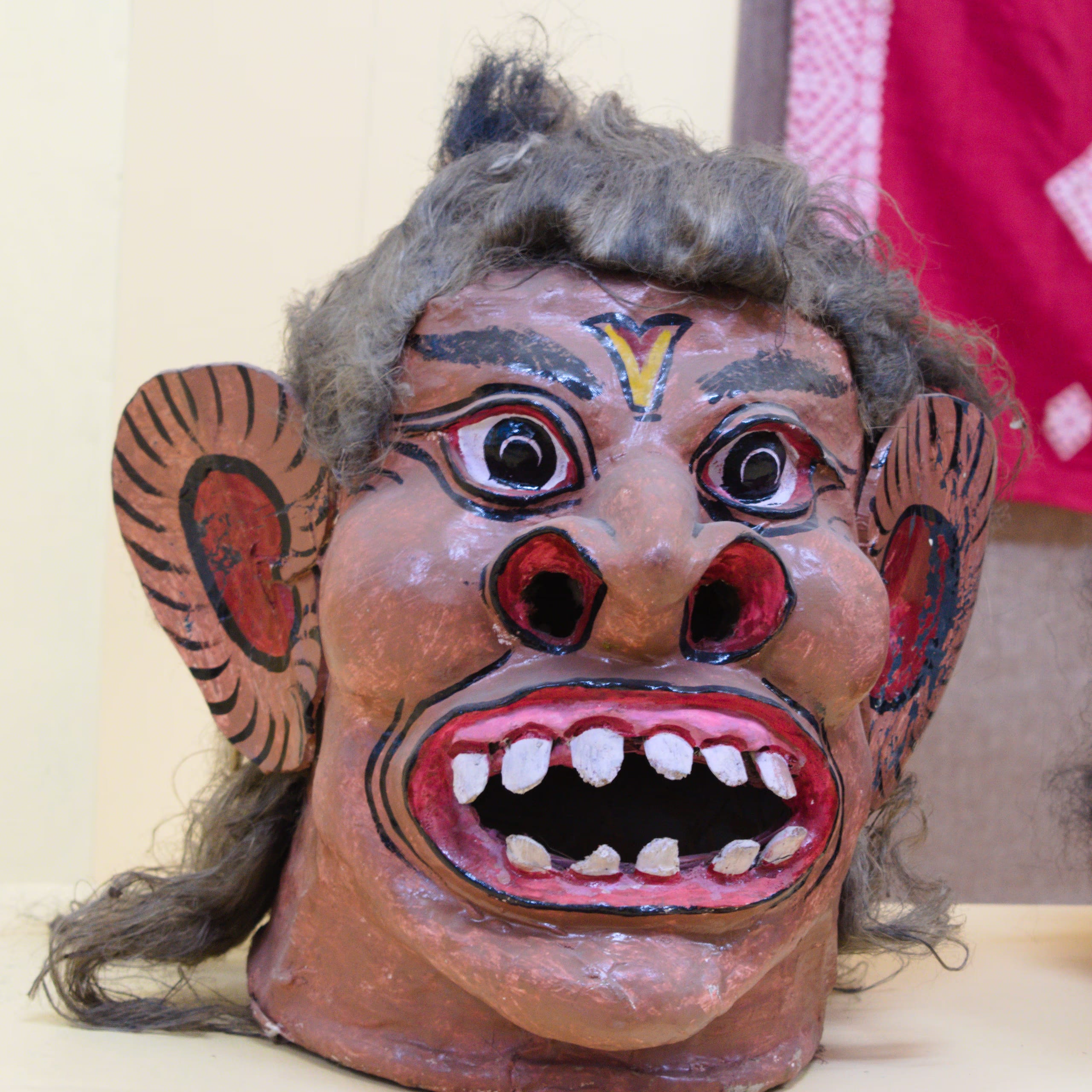
Gods, demons and beasts appear not only in costume but in the great mukha masks. The maker first weaves a lattice cage of split bamboo and cane in the shape of the head. Over this frame he lays cloth soaked in a paste of clay and cow-dung, coat upon coat, drying each in the sun before the features are modelled up in a finer mix. Only when the whole is hard and smooth is it painted in bright mineral colours. The forms scale to the character. They range from the plain face-mask (mukh), which leaves the actor's body free to dance, to the towering full-figure cho mask that swallows the actor whole and turns him into a giant Narasimha or a many-headed demon. Between them stand the articulated lotokai masks, fitted with a movable jaw and joints worked by strings, so that a Ravana or a Garuda can roll its eyes, drop its jaw and snarl at the audience.
The craft is tied above all to the Samaguri sattra in Majuli, where the monks have handed the making from guru to disciple for generations and are the most celebrated keepers of it. What began as a stage property has grown into a fine art in its own right. Samaguri masks are now shown in museums and exhibitions far from the namghar, and the sattra has drawn visitors and study to Majuli for the work alone. Yet the masks remain, first and last, made for the play: each one is built to a particular role in the Ankia Naat, and it is on the bhaona floor, in the lamplight, that it is meant to come alive.
A living tradition
Five centuries on, bhaona is still a living art. It is staged in the sattras and namghars, and at festival times in villages across the valley. Majuli is its great centre, and the Raas festival one of its high seasons. It is kept up at Janmashtami, on the death anniversaries of the gurus, at Raas and Dol Purnima, and at community gatherings, especially in upper Assam. Distinct regional forms have grown from it. The Khuliya Bhaona of the Mangaldoi country is a folk descendant of the Ankia Naat, performed in modern Assamese rather than Brajavali. There are also the great mass bhaonas, in which many village troupes play at once before huge crowds. These include the Barechahariya Bhaona of Jamuguri near Tezpur and the Hezari Bhaona of Nagaon. The form still travels. The Ankia Bhaona Ram Vijay of the Kamalabari sattra in Majuli is said to have been staged as far away as Indonesia. Bhaona is the dramatic member of the family of neo-Vaishnava arts. It is the theatre from which Sattriya dance, the Borgeet songs and the mukha masks all branch. It is the form in which Sankardev's revolution still speaks aloud, in costume and song, to the people it was made for.
From the namghar to the proscenium
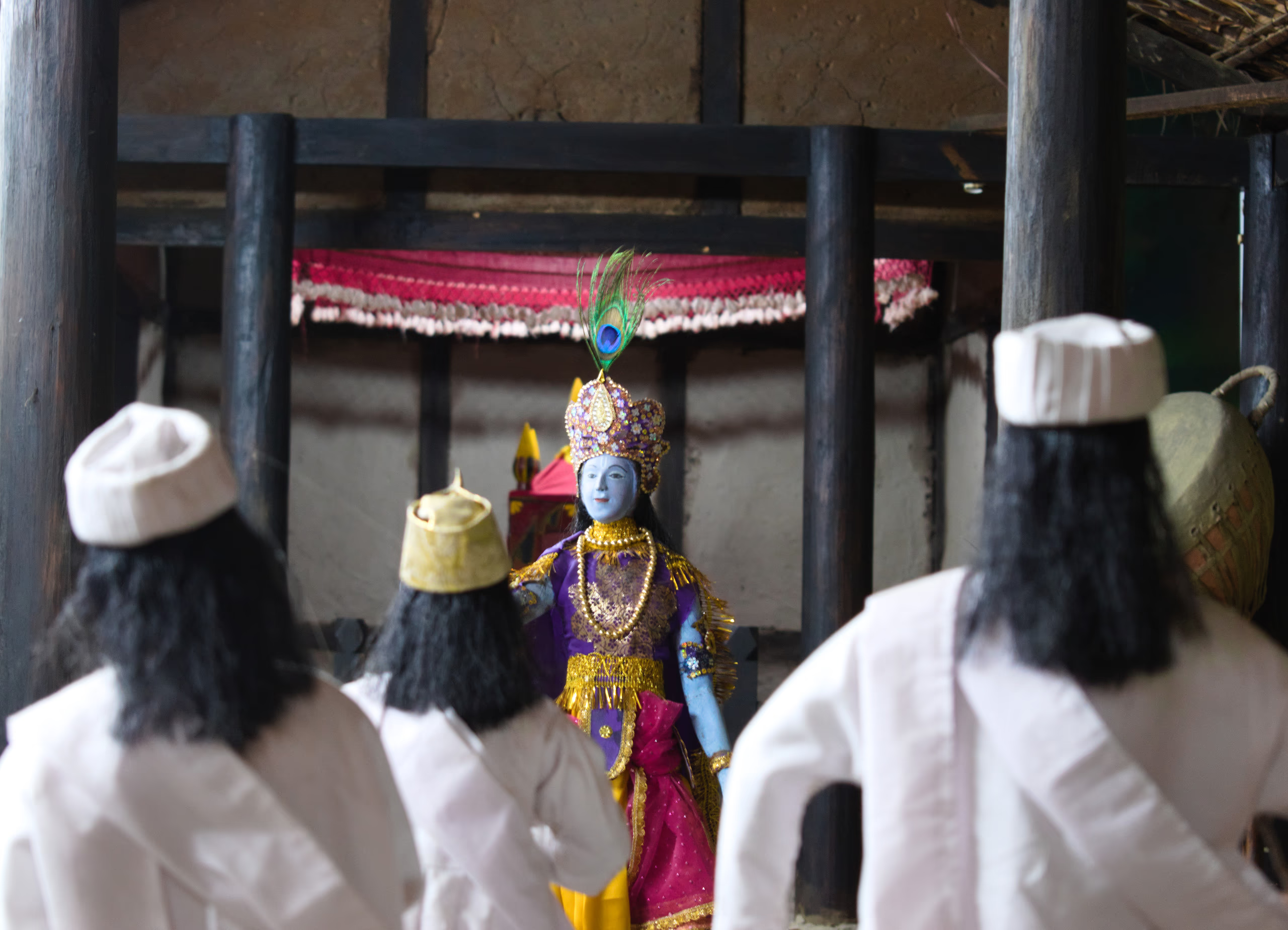
The Ankia stage held the valley almost alone until the colonial nineteenth century. Then a second, secular theatre grew up beside it. The proscenium playhouse arrived from Bengal. Assamese students returning from Calcutta had seen English-style drama there, and began to write for it. Gunabhiram Barua's Ram-Navami (1857), Hemchandra Barua's Kaniya Kirtan (1861) and Rudraram Bordoloi's Bangal-Bangalani (1872) are the early landmarks of the modern Assamese play. Touring Bengali opera and yatra troupes played the railway towns, and Assam answered with troupes of its own. The Pathshala company grew from the song-and-acting gayan-bayan of the Bajali country. It was the first to translate and perform in Assamese, and in 1917 it became the permanent Pathshala Natya Samiti. Ambikagiri Raichoudhury's song-play Jayadrath Badh (1909) is remembered as the forerunner of the Assamese yatra stage. This modern theatre is a separate stream from bhaona, secular where bhaona is devotional. But it begins in the same valley and carries on the same long Assamese habit of the staged story.