The Tai-Ahom are the community descended from the followers of Sukaphaa. He was the Tai prince who crossed the Patkai in 1228. He founded the kingdom that ruled the Brahmaputra valley for six centuries. Their origin is unique among Assam's peoples. It is a documented migration from a known homeland in the Tai world of upper Burma and Yunnan. Their later history is woven through the whole history of the Ahom kingdom they made.
A branch of the Tai
The Ahoms were a branch of the great Tai (Tai-Kadai) family of Southeast Asia. Its peoples spread across what is now southern China, Laos, Thailand and the Shan states. Sukaphaa's band came from the Shan country around Mong Mao, traced by tradition to the region of present Dehong in Yunnan or to the Hukawng valley of upper Burma. His following was small. The chronicles put it at about nine thousand people. They brought with them the whole cultural equipment of a Tai state: a Tai language and script, the sacred kingship of the Swargadeo, the wet-rice economy, and the habit of keeping the buranji chronicles. All of this was carried over the mountains into a new land. After years of wandering, Sukaphaa settled at Charaideo around 1253. It became the first capital and the royal necropolis. The state they built there left monuments of brick and stone still standing in upper Assam.

The name that became a country's
The Ahoms gave the land more than a dynasty. In the end they gave it its modern name. Before they came the valley was Kamarupa. The word Asam, which became Assam, arrived with them. The popular tradition is a proud one. The valley's people were struck by the prowess of the newcomers. They called them asama, the peerless or unequalled. This softened to ahom, the name we still use for them. In time the country took the name of those who ruled it. The careful scholarship keeps the same direction while correcting the root. Banikanta Kakati, following Grierson, held that the Tais called themselves Tai. It was the indigenous people who named the Shan newcomers Asam or Acam. The modern word Ahom is the worn-down form of that older Asam. The epithet then passed from the conquerors to their country and displaced Kamarupa. The Sanskrit sense “unequalled, uneven” came afterward, a learned rationalising of a name already in use. Other roots have been proposed too. One is an Ahom word for the undefeated, another a Bodo phrase for low-lying land. So the etymology is not finally closed.
Absorption and identity
The defining feature of Tai-Ahom history is that the migrant elite both absorbed and was absorbed. The Ahoms drew the valley's peoples into their state through a deliberate policy of intermarriage and incorporation, begun with the Morans and Borahis. Society was first ordered by clan. The oldest reckoning speaks of the Satghariya Ahom, the seven original houses, alongside the priestly and noble lineages.
Over time this kin order gave way to a system built on service. Every able-bodied man was a paik, liable to rotating labour and military duty for the state. Paiks were grouped in units, and one man from each stood in service while the others tilled the land. They were organised into khels, the occupational and militia guilds through which the kingdom raised its armies and its works. The census that bound each paik was systematised in the early seventeenth century by Momai Tamuli Borbarua under Swargadeo Pratap Singha. Officers held command by fixed number, from the Bora over twenty paiks up through the Saikia, Hazarika and Rajkhowa to the Phukan over six thousand. This paik order made the Ahom state, and its titles still survive as common Assamese surnames.
Over the centuries the court itself Hinduised. The Tai-Ahom language gave way to Assamese in daily life, surviving mainly in ritual and chronicle. The community that exists today is the long outcome of that double process. It is defined at once by descent from Sukaphaa's followers and by six centuries of blending with the valley they ruled.
The ancestors and the priests
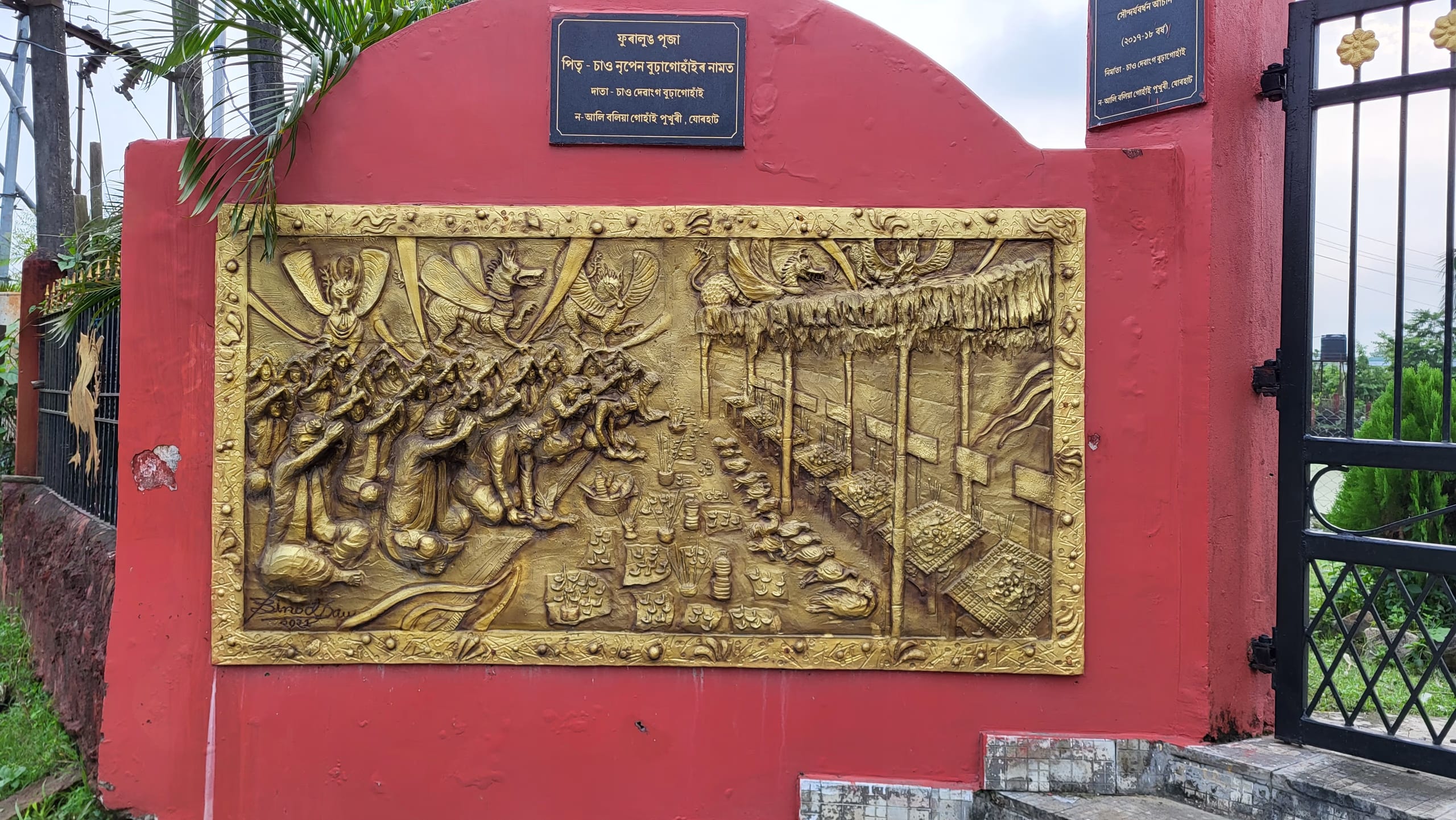
At the heart of the old Tai-Ahom religion is the worship of the ancestors. The dead are held to become guardian spirits. They are honoured in the household rite of Dam-Phi, and publicly in the great festival of Me-Dam-Me-Phi, “the offering to the dead ancestors.” It is now kept across Assam each January as the community's signal observance. The rites centre on offering and the sacrifice of animals to the ancestral and tutelary gods. They are conducted by the hereditary priestly clans: the Deodhai, the Mohan and the Bailung. These are the keepers of the Tai liturgy and lore that Padmeswar Gogoi set down. In the modern revival the faith has been organised as the Phuralung religion.
A community and its revival
In the modern period the Tai-Ahom have seen a conscious reaching-back. It is a renewed interest in the Tai-Ahom language and script, in the buranjis, and in the ancestral religion and its priesthood. Yasmin Saikia has shown how contested and constructed this revival can be. It is the very struggle to be Tai-Ahom again and to recover what assimilation overlaid.
Today the Tai-Ahom are counted in the millions, most of them in the upper Assam districts of the old heartland, around Sivasagar, Charaideo, Jorhat, Dibrugarh and their neighbours. The majority now follow Hinduism, with a minority keeping the old Tai-Ahom faith. They are classed among the Other Backward Classes, and a long-running demand seeks Scheduled Tribe status for the community. Their founder is honoured each year on 2 December as Asom Divas, the day that marks Sukaphaa's arrival in the valley. The Tai-Ahom here are a living community and a cultural identity. The political history of their kingdom belongs to the Ahom kingdom, the six-century state they founded on the upper Brahmaputra.