Joymoti, who died around 1680, is remembered as Sati Joymoti, and she is among the most honoured women in Assamese history. She was the wife of a fugitive prince, and she was tortured to death rather than betray where he was hiding. Her silence let him survive to take the throne and set right a dynasty that had nearly destroyed itself. She belongs to the darkest stretch of the Ahom kingdom, the years of court murder that opened soon after the triumph at Saraighat and closed only with the long calm of the eighteenth century. Her sacrifice became the hinge on which that recovery turned.
A court that devoured its princes
By the late 1670s the Ahom throne had fallen under the control of a kingmaker. He was Laluksola Borphukan, brother of the great Lachit Borphukan who had thrown back the Mughals at Saraighat only a few years before. From the western governorship at Guwahati that his brother had once held, Laluksola came east to master the court, and to buy himself that freedom he gave the Guwahati frontier back to the Mughals. Once in the capital he had the regent Atan Burhagohain murdered in 1679, and in the murdered king's place he raised a boy of about fourteen, Sulikphaa, remembered ever after as Loraroja, the boy-king, who reigned in name while the Borphukan ruled in fact. To hold that power the faction set about destroying the royal line one prince at a time. An old Ahom rule barred any man with a bodily blemish from the throne, so they did not always need to kill. To maim, to cut, to blind or disfigure was enough to remove a claimant for good, and the buranjis record more than a dozen princes of the royal houses put beyond the reach of the crown in this way. To be born of royal blood had become a sentence with a delay on it.
Joymoti belonged to that same high Ahom nobility. By tradition she was a daughter of the Borgohain of Madurigaon, near Sivasagar, and the buranjis name her father Laithepena Borgohain and her mother Chandradaru. She was married to Gadapani, a prince of the senior line and a marked man. Seeing what was coming, he slipped out of the killing court. He went into hiding among the hill and frontier peoples east of the valley, by tradition in the Naga hills, moving from shelter to shelter for about two years. He was the one thing the regime could not abide, a whole and able prince at large. The search for him was relentless. But Gadapani had vanished, and the only person who knew where he was would not say. So the court came for his wife.
Jerenga Pothar, and the king it made
Joymoti was seized and taken to an open field near the heartland of the kingdom. It has been remembered ever since as Jerenga Pothar. There, by the tradition the chronicles preserve, she was bound to a thorn tree and tortured for some fourteen days to force her to give up her husband. The demand never changed and her answer never came. One sentence would have ended the pain and might have saved her life. The same sentence would have killed Gadapani and handed the kingdom to the men with the knives. She carried both his life and the future of the dynasty in a single piece of knowledge. She spent her own life rather than surrender it, dying of her wounds in the field. Her endurance is the opposite of passive. Every hour of silence was a choice remade against her own agony, and it outlasted the cruelty of an entire court.
The wheel turned. The regime of terror collapsed under its own weight. Gadapani came down out of the hills to take the throne in 1681 as Swargadeo Gadadhar Singha, and was formally crowned the following year. He was the founder of the Tungkhungia line that would rule for the kingdom's last century and a half, down to 1826. The dynasty that had nearly eaten itself was steadied. He and Joymoti had two sons, Lai and Lechai, and it was the elder, Lai, who came to the throne in 1696 as their son Rudra Singha. From him and his successors came the Ahom golden age. None of it is imaginable without the silence held in a field. That is why Joymoti is counted not as a victim of the bloodletting but as the person who ended it.
Memory: a great tank and the first film
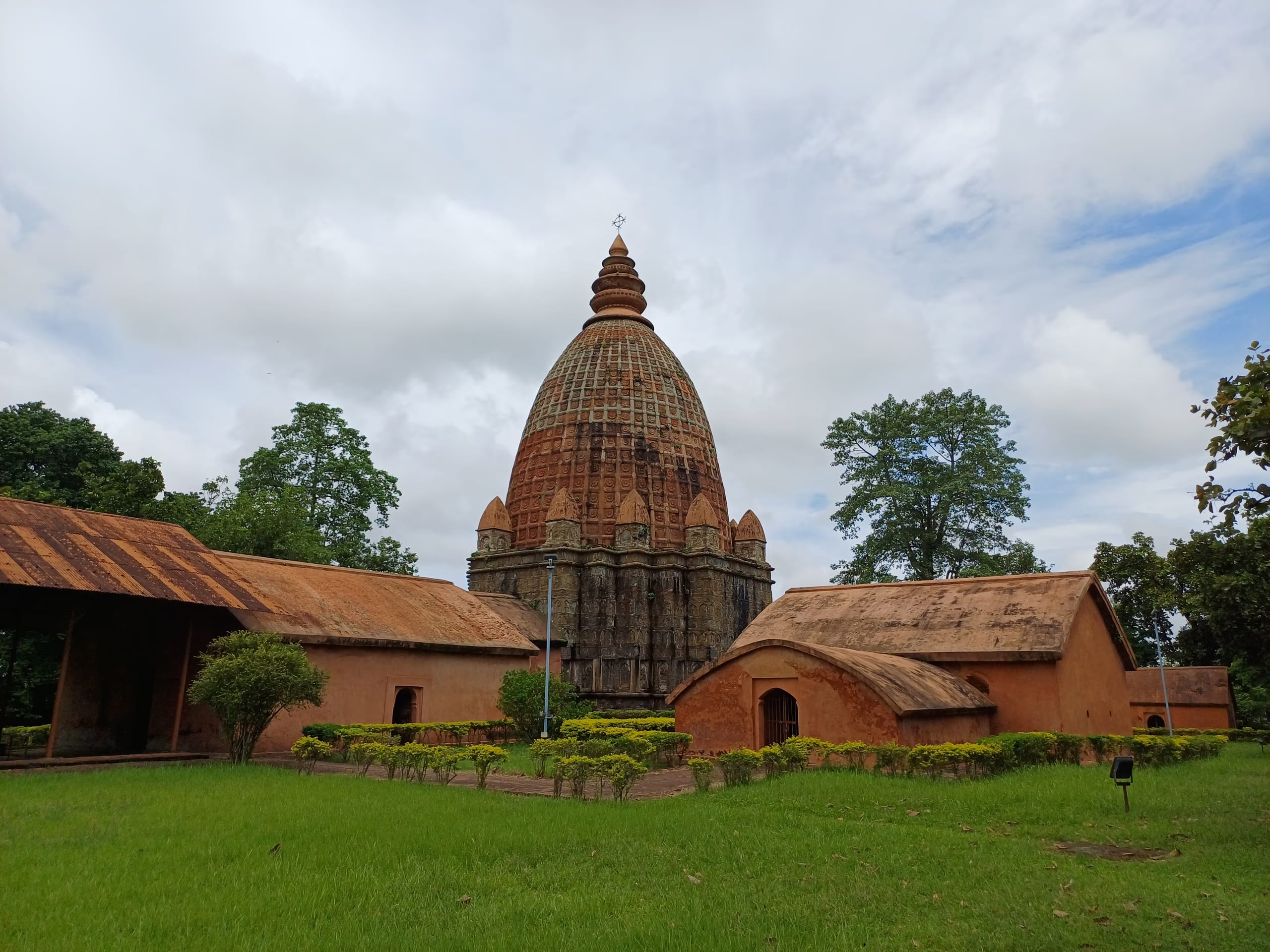
Rudra Singha did not forget whose sacrifice had made his crown possible. In her memory he excavated Joysagar, near Sivasagar, generally dated to 1697. Covering some 318 acres, it is remembered as one of the largest tanks in India, a sheet of still water that carries her name. By the tradition the buranjis keep, the whole of it was dug in forty-five days, a feat possible only for a state that could put tens of thousands of its subjects onto one site at once. He is also said to have raised a temple in her honour and to have kept her memory in gold within it.
Centuries later her story crossed into new media. The writer Lakshminath Bezbaroa gave it enduring dramatic form in his play Joymati Kunwari. Then, in 1935, the polymath Jyoti Prasad Agarwala chose the same story as the subject of Joymati, the very first Assamese feature film. So the princess whose whole act was silence became the first face and voice of Assamese cinema. If the tank was the first great memorial to her, the film was the second, and the leap from a sheet of still water to a reel of moving images is its own story of how a people keeps its dead. Assam keeps her still, for Joymati Divas is observed each year on 27 March, and a state award in her name honours women of the region.