Bengenaati is an Ahom-endowed sattra of Majuli. It is a Purush-samhati monastery, long endowed by the Ahom court, and it is known above all as a repository of the art, the antiquities and the royal relics of the kingdom that patronised it. It holds one of the richer cultural collections among the island's sattras, and behind that collection lies a house of scholarship whose keeping of manuscripts was, for centuries, a labour renewed by each generation.
A royal foundation
Bengenaati was established in the mid-seventeenth century by Muraridev, who by tradition was a grandson of Sankardev's stepmother. It was founded in the same age of royal endowment that founded the other great sattras of Majuli and bound them to the state, and that kinship places the house close to the founder's own circle. It is fitting, then, that Bengenaati is reckoned a centre of the Purush-samhati, one of the four orders into which the neo-Vaishnavite movement divided after Sankardev and Madhavdev, and the branch carried forward within the founder's own line.
The grants of land and dependants it received made its satradhikar a figure of standing in both the religious and the worldly life of the late kingdom. What that patronage bought, for the crown, was a share in the sanctity of a house tied by blood to Sankardev himself; what it bought for the sattra was the wealth and the protection to build a collection and a school that would outlast the dynasty that funded them. Like its sisters, Bengenaati carried the daily round of a working monastery, the worship in the namghar, the recitation of scripture and the chanting of the divine name, and that round went on through the long centuries, and through the erosion that has steadily reshaped the island around it.
A treasury of the kingdom
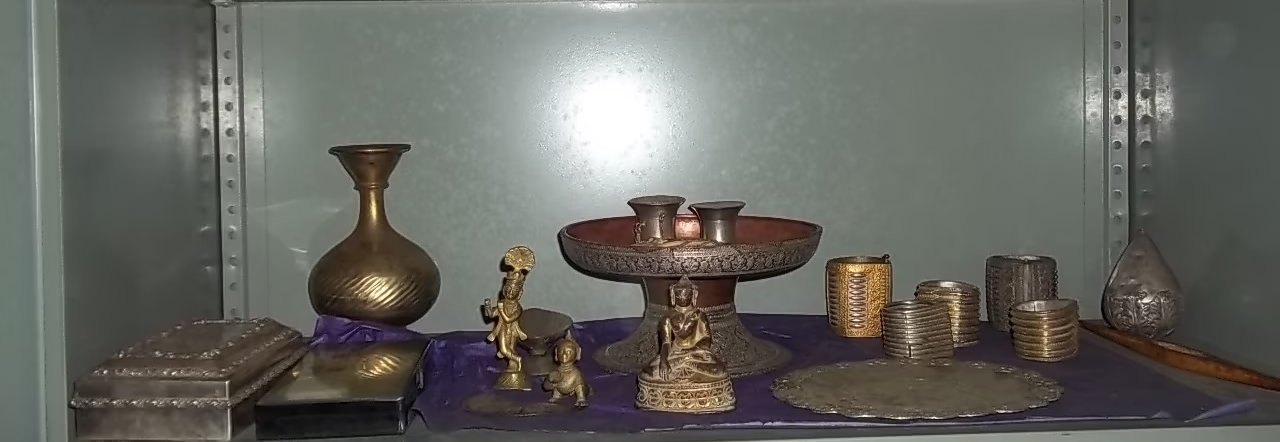
What sets Bengenaati apart among the island's sattras is what it has kept. Its collection preserves royal gifts and relics of the Ahom court: regalia, ornaments, ritual objects and, with them, the manuscripts of the worship. So the sattra is a small museum of the kingdom as much as of the faith. In these objects the close bond between the Ahom throne and the Vaishnava monasteries can be seen directly, for the same kings who endowed the sattra with land also gave it the things of their court, and the monastery has guarded them as carefully as its scriptures. It has long been, too, a centre of the arts of the tradition, the Sattriya dance and the devotional music among them.
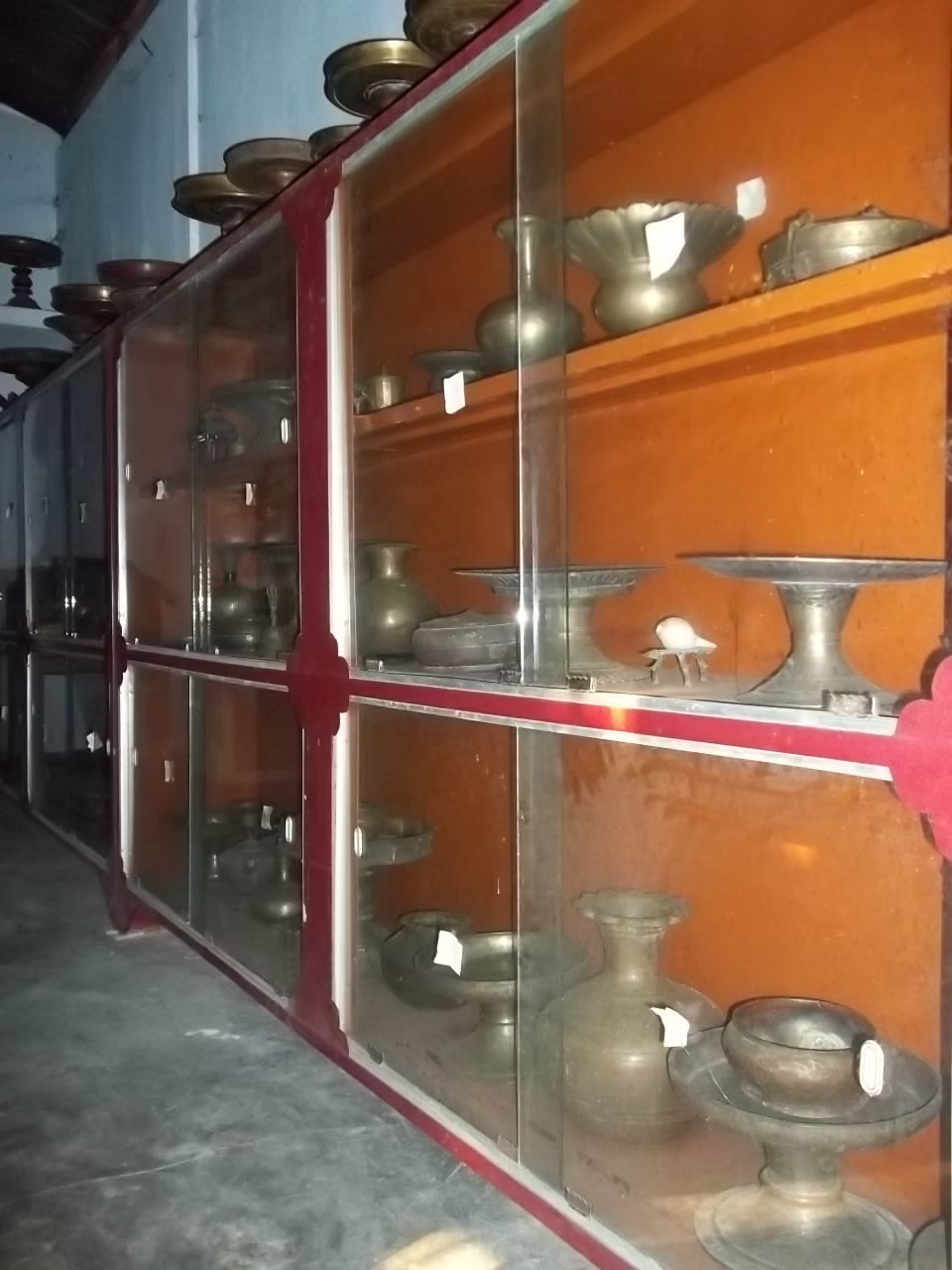
The jewel of the collection, by long tradition, is a royal garment worked in gold, held to have belonged to the Swargadeo Gadadhar Singha and given to the sattra as a mark of the throne's devotion. It is a telling gift to have survived, for Gadadhar Singha is remembered as a hard and able king who, in his own reign, curbed the power of the very Vaishnava sattras that had grown too strong for the crown's comfort. That a garment of his should be treasured here, at a sattra, is a reminder that the long quarrel between throne and monastery ran alongside a long intimacy, and that the same dynasty could both discipline the sattras and endow them. Beside the garment the monastery is said to hold a royal umbrella crafted of gold, the kind of regalia that marked a king's person, so that the sattra preserves not only the cloth a Swargadeo wore but the emblems of his sovereignty.
With these go palm-leaf and sanchipat manuscripts of the scriptures and the chronicles, the illustrated religious texts that the sattras both copied and preserved, and the ornaments and ritual vessels of three centuries of worship. To step into Bengenaati is thus to enter a working archive of both the faith and the kingdom that sustained it, and it is for this that the house has come to be described as a reliquary of culturally significant antiquities as much as a place of prayer. The care of such collections has been the quieter vocation of the Majuli sattras alongside their worship: in an age before public museums, it was the monasteries that kept the manuscripts, the regalia and the memory of the Assamese past. Bengenaati's holding is among the reasons the island is reckoned a treasury of the culture. That a reform of the heart should also have made its houses the archives of a civilisation is one of the quieter legacies of Sankardev, the saint whose movement gave rise to these monasteries.
A seat of learning and its keepers
Bengenaati was not only a strongroom of relics but a house of scholarship. Its satradhikars counted among them men of learning who copied, composed and taught, and the monastery's preservation of palm-leaf and sanchipat manuscripts was the active work of a community that read and recited them, not the passive survival of a hoard. In an Assam without colleges or public libraries, the sattra was the school, the scriptorium and the archive at once, and Bengenaati's standing rested as much on the scholars it raised as on the treasures it held.
The house of learning was, in the end, a house of people. A sattra of this order was home to a resident brotherhood of bhakats, the disciples who took up residence in the ranks of cells, or hatis, that ringed the central prayer-hall. It was among them that boys came to be schooled, and it was they who kept the routine of copying and recitation from one generation to the next. In such a community the transmission of learning was less a matter of formal instruction than of apprenticeship: a novice learned the scriptures by hearing and reciting them, and learned the scribe's craft by sitting beside those who practised it. The satradhikar presided over this life as its head and teacher, and the office passed on within the tradition of the Purush-samhati order to which the house belonged.
To keep a manuscript alive in a climate that rots palm-leaf was itself a labour of scholarship, for a decaying text had to be recopied by hand before it was lost. The learning Bengenaati preserved was therefore never a fixed possession but a discipline renewed by each generation that read, recited and rewrote it. A manuscript here is not an object that happened to endure; it is the last in a line of copies, each made by a hand that understood what it wrote, and each testifying that the text mattered enough to be saved once more. In that sense the collection and the scholarship were never two things. The archive survived because the school was alive, and the school stayed alive by tending the archive.
Carrying the treasure before the river
That such a collection survives at all is a small wonder. The island has eroded away beneath the Brahmaputra, so the relics of the kingdom that Bengenaati guards have had to be carried inland ahead of the water, along with the faith. The keeping of these things is thus not a settled custodianship but a running rescue: a collection assembled in the confidence of royal favour, borne from site to site three centuries on. The wider account of how the river is steadily eating the island belongs with Majuli's own article; what belongs here is what that pressure has asked of this one house.
What it has asked is that the treasure be moved, and moved again, whenever the water came too close. A gold garment, a gilt umbrella, a chest of palm-leaf manuscripts: these are at once the proof of a vanished kingdom's devotion and the charges of a community that has refused, generation after generation, to let the river have them. There is a particular poignancy in it. The objects were given in the certainty that Bengenaati would stand forever on its ground, tokens of a permanence the donors never doubted; and they have endured only because the community that received them gave up any such certainty and learned, instead, to carry. This is why the people of Majuli speak of their sattras not as buildings but as charges held in trust against the water, and why Bengenaati's collection is, in the end, less a hoard than a promise repeatedly kept.
Visiting
Bengenaati lies on Majuli, reached by the ferry from Nimati Ghat near Jorhat and the island road. Its collection of relics and manuscripts is the thing most worth coming for. It is an active monastery, entered with the observances proper to a place of worship. The autumn Raas, when the sattras of Majuli stage the life of Krishna, is the most extraordinary season to come. Pair it with the island's royal houses, the Auniati Sattra and the Dakhinpat Sattra, and with the Garamur Sattra and the dance-and-music house of Kamalabari along the same circuit, and the cool, dry months from November to March are by far the easiest time to make the crossing.