Auniati is one of the four great royal sattras of Majuli. For much of its history it was among the wealthiest and most powerful monasteries of the whole neo-Vaishnavite tradition. It was founded under direct Ahom patronage, and so it grew into an institution of the kingdom as much as of the faith. It held estates and thousands of disciples, its abbot sat among the great men of the realm, and its influence reached far beyond the island that housed it.
A royal foundation
Auniati was established in 1653 by Niranjan Pathakdeva, known in the tradition as Niranjandeva, who became its first satradhikar. Its patron was the Ahom king Jayadhwaj Singha, who ruled in the middle of the seventeenth century. This was the very reign in which the Ahom court had itself taken to Vaishnavism. Jayadhwaj Singha received formal initiation into the faith, and the crown drew the sattras into a close and deliberate relationship with the state. The founding of Auniati belongs to that turn: a monastery raised by royal will as much as by the impulse of the faith, and one meant from the outset to stand near the throne.
That royal character shaped the endowment from the first day. The crown made grants of land and of paiks, the dependants assigned to work it, so that the sattra was given not only a site but a revenue and a labour force. These grants made Auniati one of the richest monasteries in Assam, and they made its satradhikar a figure of real standing in both religious and worldly affairs. He was consulted by kings, his blessing was sought at accessions, and he ranked among the counsellors of the realm. A sattra so founded was never a purely spiritual house. From its first day it stood inside the machinery of the kingdom, and the story of Auniati is, for that reason, also a chapter in the story of Ahom power.
The place of Auniati among the sattras was later formalised. When Rudra Singha and his successors set the affairs of religion in order at the opening of the eighteenth century, they recognised a small number of monasteries as royal sattras, endowed and protected by the crown and answerable to it, and Auniati stood in the first rank of them. To be a royal sattra was to enjoy the crown's wealth and the crown's expectation together: land and disciples on one hand, and on the other a duty to the throne that the more independent, egalitarian orders of the faith never carried.
The Brahma-samhati and its worship
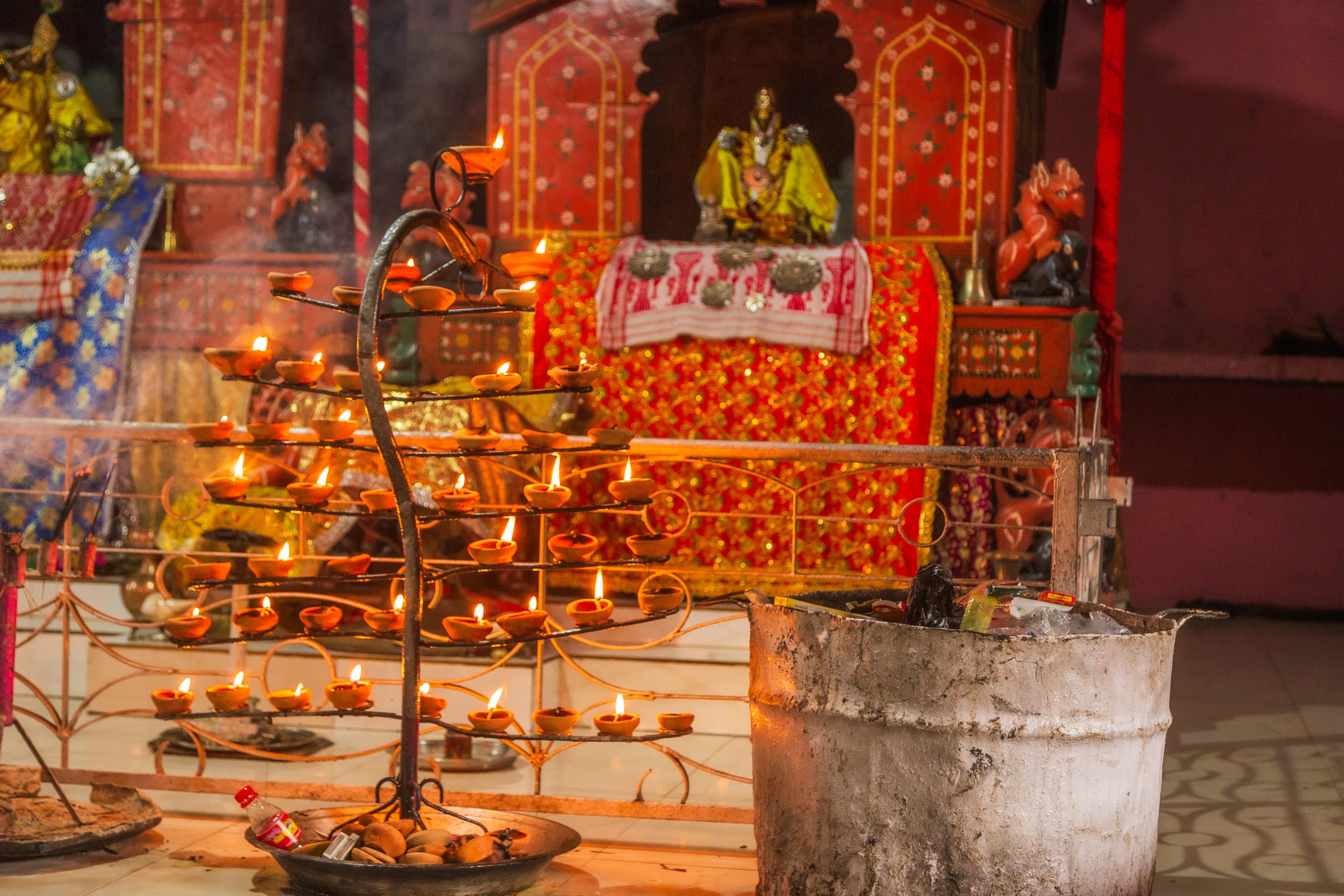
Auniati belongs to the Brahma-samhati, one of the four orders, the samhatis, into which the movement divided after Sankardev and Madhavdev. It is the branch descended from Damodardev and Haridev, and of the four it retained the most of Brahmanical ritual, image-worship and caste observance. Where the stricter orders founded by Madhavdev's line kept the altar bare but for the sacred book, the Brahma-samhati gives the worship of the image a central place alongside the chanting of the name. That doctrinal character is written into the daily life of Auniati: the deity is served with the forms of temple worship, and the Brahmanical calendar is kept, even as the congregational chant remains the heart of devotion.
The devotional life of the monastery turns on the namghar, the great prayer-hall, and on the Paalnaam, the sustained collective chanting of the divine name that can run for days at the great festivals. Around it moves the ordinary round of a working monastery: the bhakats at prayer through the watches of the day, the reading and recitation of scripture, the offering of food to the deity, and the observance of the Vaishnava year. The resident monks live as a celibate order, the udasin bhakats, who renounce household life and give themselves wholly to the sattra; their discipline of prayer, service and study is the spine on which the whole institution stands.
The line of satradhikars founded by Niranjandeva has held an unbroken succession since 1653, each abbot in turn the spiritual head of the whole far-flung Auniati congregation. The office is not merely honorific. The satradhikar governs the monastery's discipline, its estates and its scattered disciples, ordains and instructs, and carries the authority that makes Auniati, in the phrase the tradition uses of such houses, a seat and not only a shrine. The continuity of that line, unbroken across more than three and a half centuries and across the loss of the sattra's own ground to the river, is itself one of the things that gives Auniati its weight.
Wealth, power, and the kingdom
Auniati's closeness to the throne made it powerful and, at times, exposed. The royal sattras held great wealth and large bodies of disciples, and this gave them a weight in the affairs of the late Ahom state that the crown both used and feared. A satradhikar who could speak for tens of thousands of initiated households, and who controlled land and men, was a force no king could ignore; and a force a king might also come to distrust.
That double edge cut hardest in the eighteenth century, when the court's turn to Shakta worship set it against parts of the Vaishnava world. The great rift of the age lay between the crown and the egalitarian Moamoria order, whose humbler and largely tribal following had been drawn from exactly the people the high sattras and the court held beneath them; the persecution of that order and its guru lit the Moamoria rebellion that broke the kingdom. Auniati stood on the other side of that divide, among the aristocratic royal sattras bound to the throne, and its fortunes rose and fell with the crown it served. The history of the monastery cannot, therefore, be told apart from the history of the state. It is the history of a house that was at once an estate, a seminary and a power, and that shared in both the confidence and the ruin of the dynasty that made it.
For all that entanglement in the affairs of kings, the faith Auniati carried reaches back past the Ahom court to Sankardev himself, the saint who set the whole neo-Vaishnavite movement in motion a century before the sattra was founded. That a single island monastery, planted in 1653, could grow within a few generations into so weighty a house is one measure of how deeply the reform had taken root once it began, and of how completely the kingdom that once eyed the movement with suspicion had come to build its own authority upon it.
The arts and the press
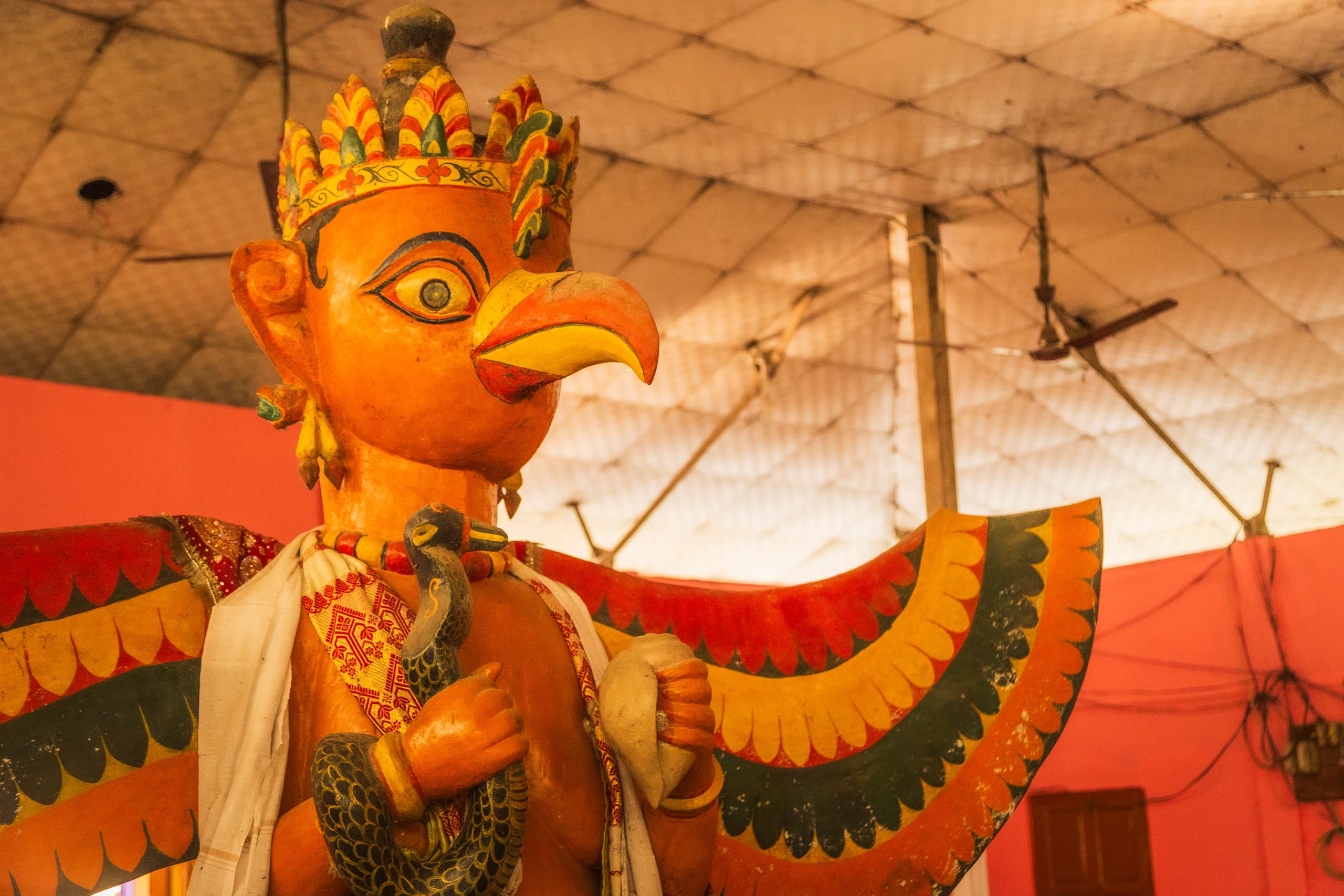
The festivals that gather Auniati's flock are also when the sattra's own arts are most fully on show, for like the other royal sattras it has long been a centre of the performing and manuscript arts of the tradition. Every great monastery of Majuli developed its own strengths within the wider Sattriya world that Sankardev's movement created, and the form particular to Auniati is the Apsara dance, a graceful and courtly number long associated with the sattra and performed by its bhakats. Alongside it the sattra maintains the full apparatus of the tradition's performance: the borgeet sung at worship, the recitation and the ritual dance that mark the festival nights, and the training of young bhakats in these forms as a part of their monastic discipline rather than as a stage art.
The sattra is also a keeper of things. It holds a substantial collection of manuscripts, ritual objects, royal gifts and the ceremonial goods of centuries, so that its museum is a small archive of the Ahom kingdom that patronised it as much as of the faith it serves. Illuminated manuscripts on sanchipat bark, weapons and utensils, the ornaments and vessels of royal donation: these are the material record of the close bond between the crown and the sattra, gathered and kept where the two histories meet.
Its reach was not only spiritual but, in time, intellectual. Under the satradhikar Dattadeva Goswami the sattra acquired a modern printing press, the Dharmaprakash press. From it in 1871 it began to issue Asam Bilasini, reckoned the second of the Assamese periodicals after the Baptist missionaries' Orunodoi of 1846. A river-island monastery thus ran one of the earliest presses in the language, printing scripture and devotional matter for its scattered congregation and carrying the written word out to households far beyond the island. That a sattra should turn from the sanchipat manuscript to the printing press, without ceasing to be a sattra, is the surest measure of how far Auniati's resources and ambitions ran beyond the ordinary work of a monastery.
A far-flung flock
The press was only one expression of a reach that ran far beyond Majuli. From the mother house its abbots initiated disciples by the tens of thousands across upper Assam, and the branch sattras they planted carried the Auniati discipline and the Auniati lineage far from the island. To belong to Auniati was therefore a religious identity held by households who might never once set foot on Majuli: a dispersed congregation bound to the sattra by initiation and by the annual rhythm of its festivals, sending offerings inward and receiving the guru's authority outward. It is precisely this network of disciples, and not the island acreage alone, that made the satradhikar of Auniati a power in the land.
The river has taken much ground from the island over the past century, and Auniati, like its sister sattras, has had to reckon with a shrinking Majuli; the wider story of that erosion belongs to the island's own account. Even so, the monastery remains one of the living centres of the faith rather than a monument to it, and here its scattered flock is its strength. A monastery whose whole congregation is an island can be lost with the island. But one whose disciples are spread across the mainland carries its life wherever they are, and the daily Paalnaam at Auniati is echoed, in a real sense, in every branch house and every household initiated from it. That breadth gives Auniati a resilience the more locally rooted sattras do not have, and it is why a house that has already lost so much of its ground has lost none of its standing.
Visiting
Auniati lies in the western part of Majuli and is among the most visited of the island's sattras. It is reached by the ferry from Nimati Ghat near Jorhat and the road across the island. It is an active monastery, to be entered with the observances proper to a place of worship. The museum, which preserves antiquities of the Ahom period, royal gifts, old utensils, ornaments and weapons, and palm-leaf and sanchipat manuscripts, is the thing most worth timing a visit around, together with the daily Paalnaam and, if the hour allows, the Apsara dance for which the sattra is known. The most extraordinary season to come is the autumn Raas, when the sattras of Majuli stage the life of Krishna over several nights and the island fills with pilgrims. Take in two of the island's other royal sattras on the same circuit, the Dakhinpat Sattra and the Garamur Sattra, along with the renowned Kamalabari Sattra, and the cool, dry months from November to March are by far the easiest time to make the crossing.