The Hayagriva Madhava temple stands on the Manikut hill at Hajo, the principal shrine of a ridge sacred to three faiths. It is a stone temple dedicated to a form of Vishnu. It is among the most venerated Vaishnava sites of the lower Brahmaputra. It is also revered by Buddhists, who hold it connected with the Buddha.
An ancient shrine, rebuilt and revered
The site is of great antiquity. Its traditions reach back to the early Kamarupa centuries. The present stone temple is generally attributed to a rebuilding by the Koch king Raghudeva Narayan in 1583, on far older foundations. Its long patronage by the Koch and later rulers ties it into the political history of the western valley. The temple enshrines an image worshipped as Madhava, a form of Vishnu. The name Hayagriva links it to the horse-headed aspect of the god. Its worship follows the Vaishnava devotion of the region. It remains a living place of pilgrimage, busiest on the festival days of the Vaishnava year.
What makes the shrine unusual is that its sanctity is shared. A persistent tradition, strong among the Bhutanese and Tibetan Buddhists who make pilgrimage here, identifies the temple as a place of the Buddha's sanctity, by some accounts the very site of his attaining nirvana. That double reverence, Hindu and Buddhist at once, is part of what makes Hajo so singular a meeting of traditions.
The temple on the ridge
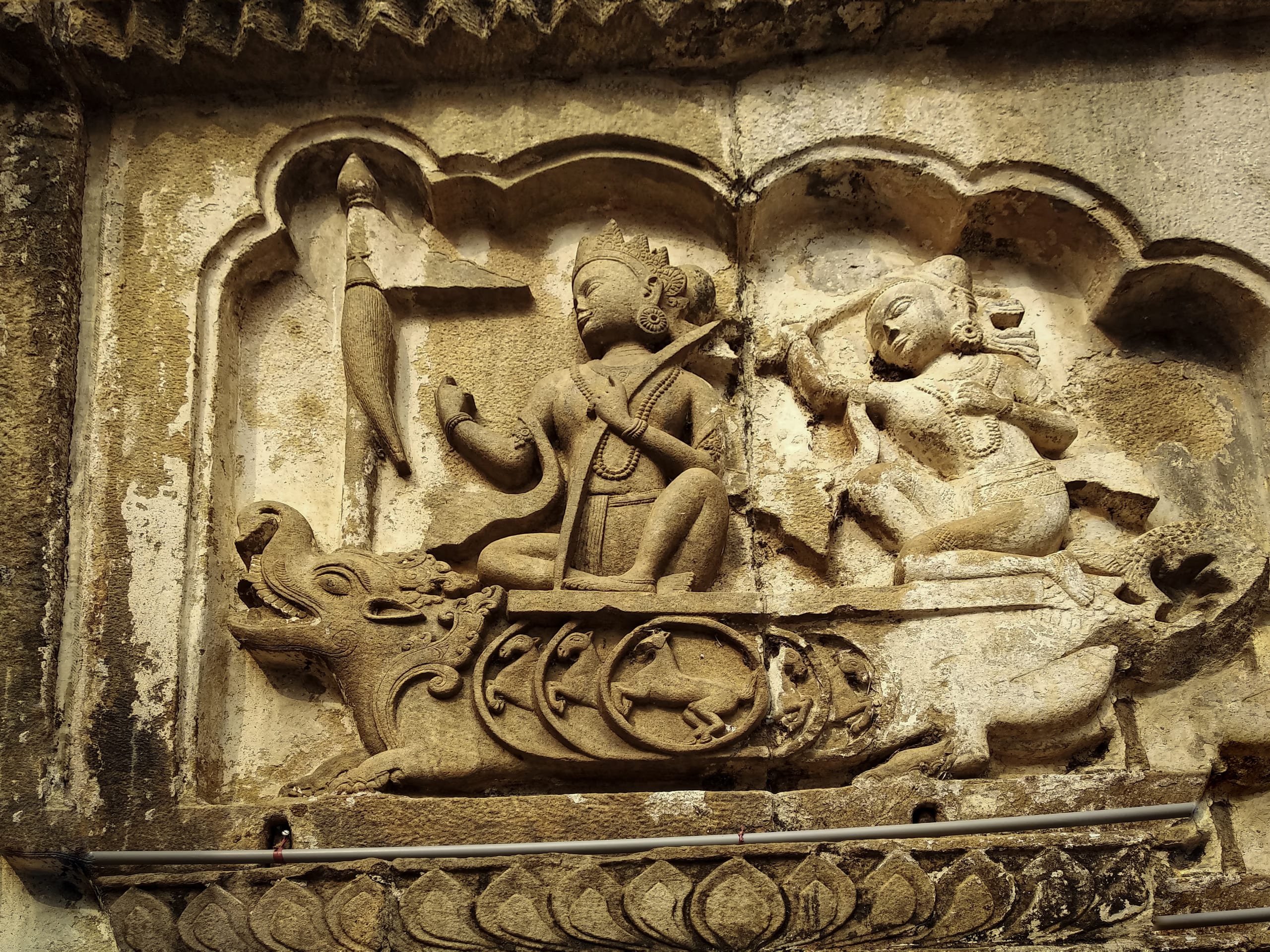
The temple is a stone structure of the Koch rebuilding. It is approached up a flight of steps cut into the Manikut hill, and set about with carved figures, panels and inscriptions. The outer walls are worked with reliefs of the ten incarnations, the dasavatara, of Vishnu. The sanctum holds the dark image worshipped as Madhava.
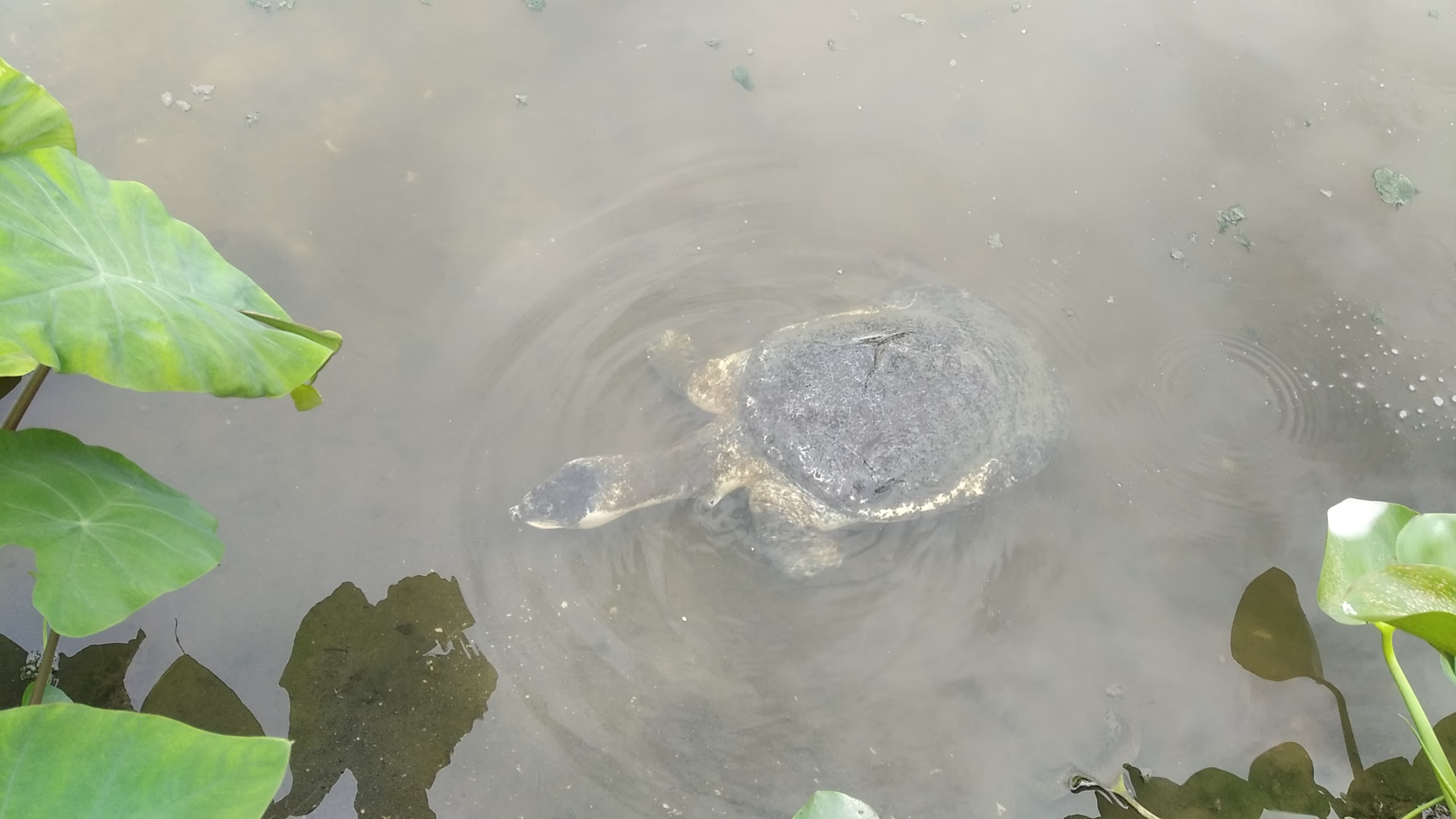
Below the temple lies a large stone tank, the Madhab Pukhuri. Its old soft-shelled turtles are fed by pilgrims and have become part of the place's character. These are the black softshell turtle, Nilssonia nigricans, a rare freshwater turtle once declared extinct in the wild and now reckoned critically endangered. Pilgrims revere them as living forms of Kurma, the tortoise incarnation of Vishnu, and so the temple's own faith has protected them. The species survived chiefly in just such sacred temple ponds. In recent years conservationists have hatched young from the Hajo tank and released them into the wild. So the sacred pond is one of the refuges that carried the turtle through.
The temple year turns through the festivals of the Vaishnava calendar. Hajo is at its most alive during the spring Doul, the local Holi, and on Janmashtami. On those days the steps and the courtyard fill with worshippers, music and offerings.
Visiting
Hajo lies about 25 km north-west of Guwahati, across the Brahmaputra, an easy half-day outing. The Hayagriva Madhava is the first of the ridge's shrines most visitors see, reached by the stepped climb up the Manikut hill. It shares the range with the Powa Mecca and the Kedar temple, so that Vaishnava, Islamic and Saiva devotion sit within sight of one another. It is an active temple, entered barefoot and with the usual observances. The cooler, drier months from October to March are the most comfortable for the visit. Festival days are the most crowded, but also the most vivid.