If Sattriya is the sacred classical dance of Assam, the Bihu dance is its joyous secular counterpart, the exuberant folk dance of the spring festival that the young perform in the open to the driving beat of the dhol and the cry of the pepa. Older than any kingdom that ever ruled the valley, and openly about youth, fertility and courtship, it is more than any other performing art the public face of Assamese culture.
The dance of the spring
The Bihu dance belongs to Rongali (Bohag) Bihu. This festival opens the Assamese year in mid-April, with the sowing season. The dance's roots reach back past written history. They lie in the fertility rites and harvest celebrations of the valley's pre-Aryan, Tibeto-Burman peoples. That is why its themes are so frankly of the body and the renewing earth. And that is why it belongs to the agricultural calendar, rather than to any court or temple. The dance is demonstrably old. Its earliest surviving images are carved on the ninth-century sculptures of the Tezpur and Darrang country. So the postures the young still strike in the field answer figures cut in stone more than a thousand years ago. It also enters the written record early. A fourteenth-century copper-plate inscription of the Chutia king Lakshminarayan is generally cited as an early documentary reference to the dance. It is a folk dance in the fullest sense: communal, participatory and rooted in the village. It belongs to the festival complex that Praphulla Datta Goswami studied through its songs and seasons.
The forms and the body of the dance
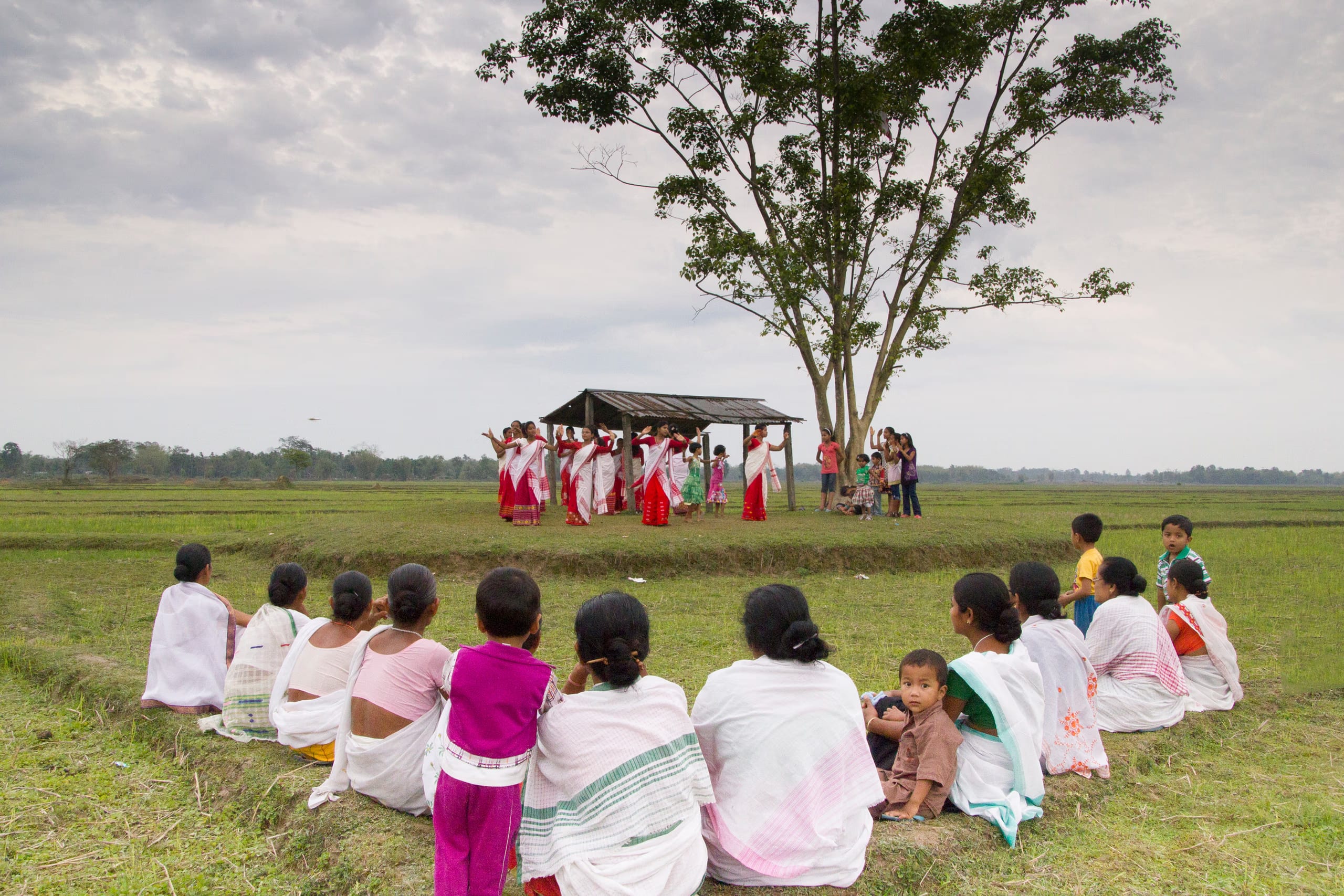
Bihu dancing is not a single thing but a family of related forms. The Husori is the men's procession. Troupes move from house to house through the Bihu week, singing blessings in each courtyard and receiving offerings in return. The Mukoli Bihu is danced in the open fields. It is the courtship dance, where young men and women perform together. This is the setting in which Bihu's romance is most alive. The Jeng Bihu is named for the fence (jeng) the women once stood behind. It is danced by women among themselves. Each form shares a common vocabulary, but carries its own setting, etiquette and mood.
That shared vocabulary is what holds the family together. The dance is built on swift footwork, supple hip and waist movements, and a precise vocabulary of hand gestures and turns. It demands great flexibility and stamina of the dancers, who must hold rhythm and grace at speed. The men's dancing tends to the athletic and the leaping. The women's tends to the fluid and the intricate. The two answer each other across the dancing ground.
The gestures are not abstract. The movements carry, in stylised form, the actions of sowing, of the bird and the river, and of courtship. So the choreography is in a real sense a danced account of the agrarian year, and of the life it turns on. It is this rootedness in the seasonal round that ties the dance back to the fertility rites from which it grew, rather than to any court or temple discipline.
Rhythm and instrument
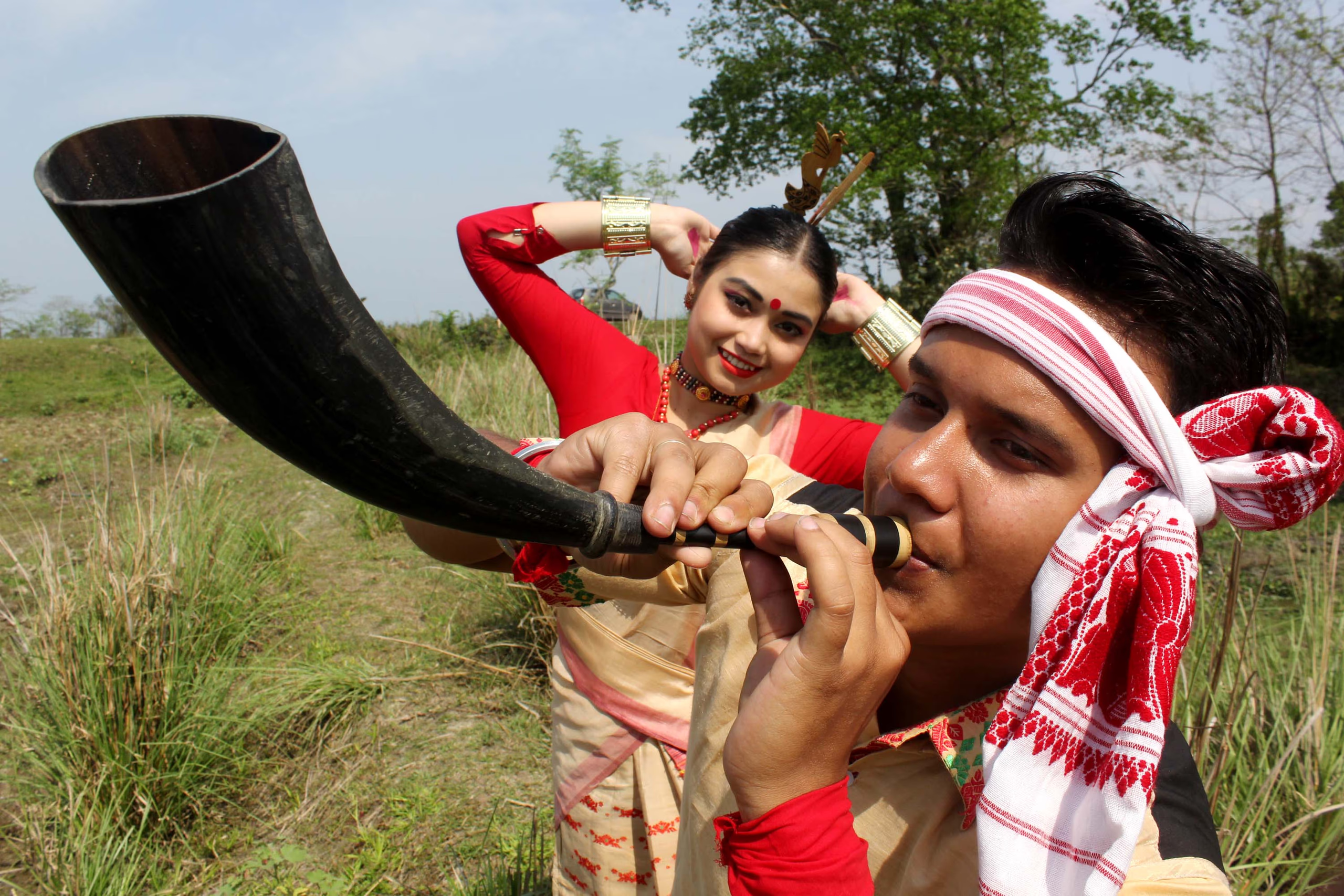
The dance is inseparable from its music. The leader of both is the dhuliya, the dhol player. His two-headed drum carries the rhythm unbroken from the first beat to the last. Around it the other instruments enter and fall away by turn. There is the pepa, the buffalo-horn pipe whose plaintive call is the unmistakable voice of Bihu. There is the gogona, a bamboo jew's-harp twanged between the teeth. And there are the taal cymbals, the toka clapper and the xutuli clay whistle. Inseparable again from the instruments are the Bihu songs, the Bihu-naam, by turns romantic, teasing and plaintive. In them, couplets of love and longing are traded across the dance. The song repertoire is as central to the form as the choreography. It is among the folk traditions catalogued in the handbooks of northeastern folklore.
From the field to the stage
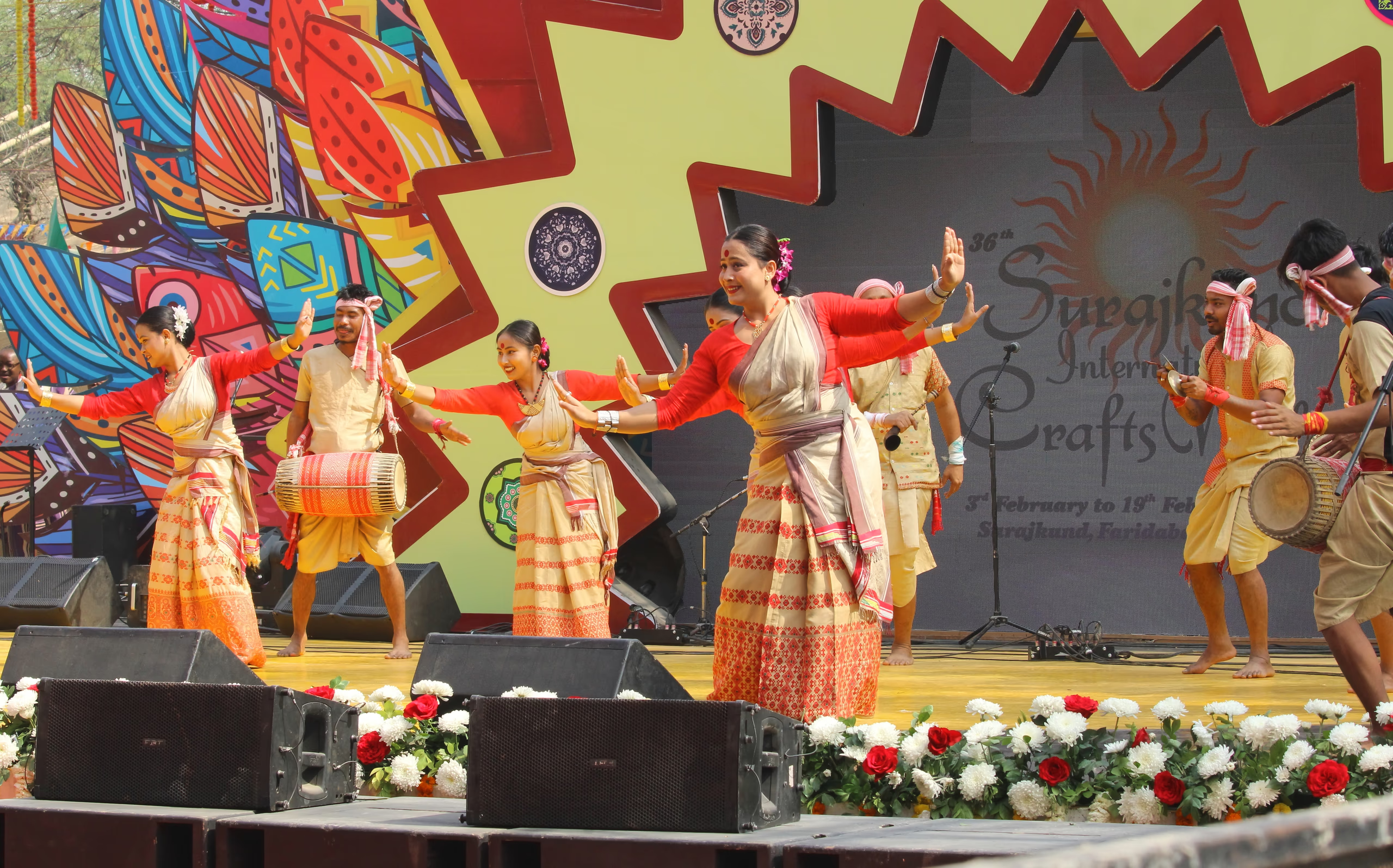
In the past, Bihu dancing was patronised by the Ahom court. By tradition the court invited the dancers to perform in the open ground before the king. The chronicles recall spring festivities staged on the great field before the Rang Ghar, at the royal seat near Sibsagar. In the modern period the dance has moved decisively from the field to the platform. It is generally held to have come onto a public stage for the first time in 1962, at a cultural event in Guwahati. From there grew the competitive Bihu of the towns: the husori contests, the floodlit mela stages, and the televised nights in which troupes from many villages dance for a prize. The scale this can now reach was made plain on Bihu day, 14 April 2023. Some eleven thousand dancers and drummers gathered in a single Guwahati stadium, the Indira Gandhi Athletic Stadium. They set a world record for the largest Bihu performance ever held. That passage has made the dance more visible than ever as an emblem of Assamese identity. Yet it has also raised the same questions of tradition and change that follow every folk art onto the stage, the movement Maheswar Neog set within the long continuum of the Assamese arts. Through all of it the dance remains what it has always been: the dance of Rongali Bihu, the spring festival of the Assamese new year whose week of celebration it animates.