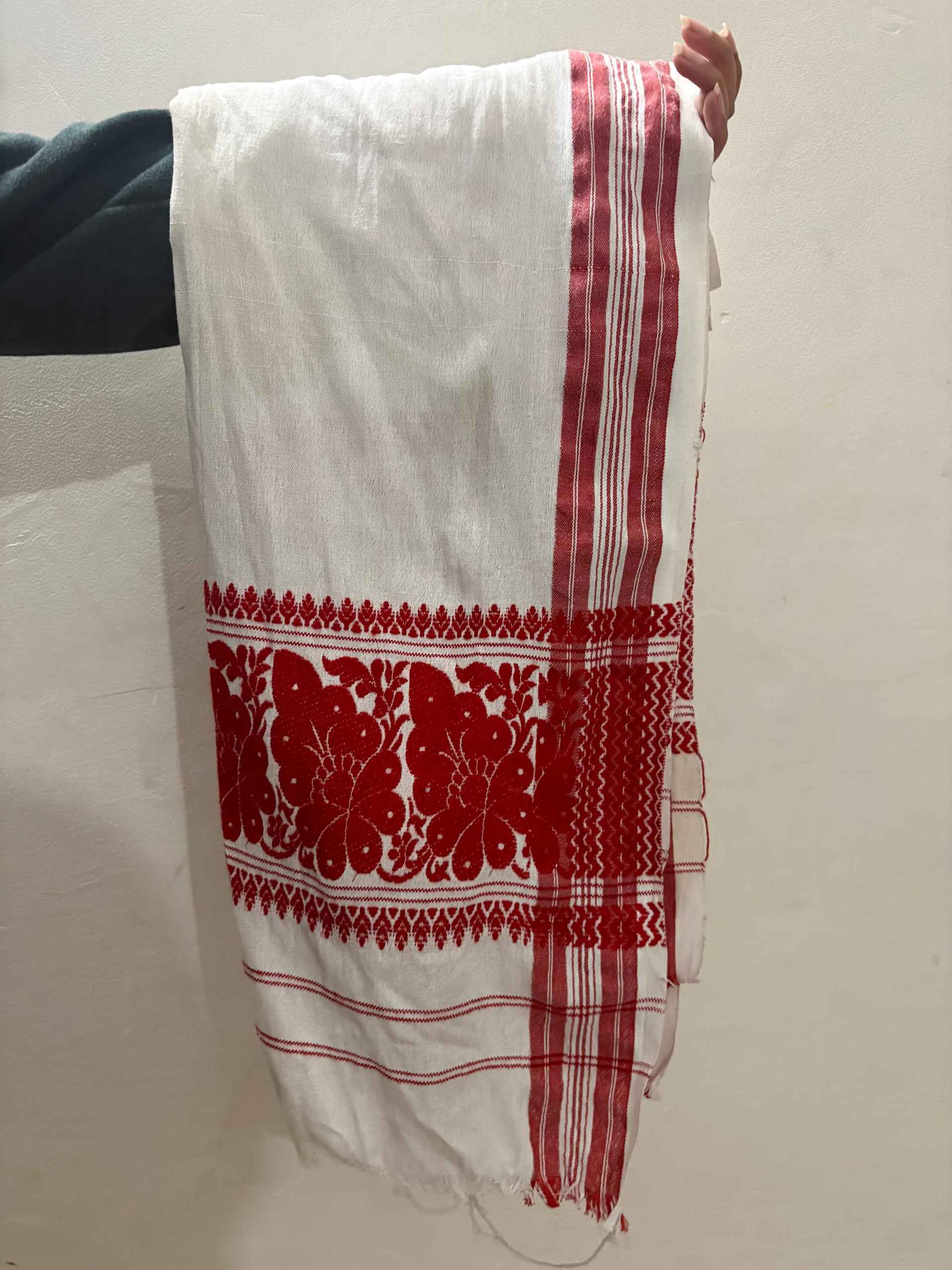
The gamosa is the red-bordered white cloth of Assam, the single most recognisable emblem of the Assamese people and their culture. It is a rectangle of handwoven cotton, white through the body and bordered with a band of red most often at the two ends, and its name is usually read literally as “something to wipe the body with,” from ga, the body, and musa, to wipe. Yet that reading badly undersells the cloth, for to call it only a towel misses almost everything it means in Assamese life. The same plain rectangle is at once the most ordinary and the most charged object in the culture, a daily towel that is also the supreme token of honour and welcome, wrapped around the neck of an honoured guest, laid over the offering-stand, given as the first gift of the year at Bohag Bihu, and carried as a banner of identity wherever Assam wishes to be seen. In 2022 it was granted its own Geographical Indication, the legal recognition of a cloth that is, in every sense, Assam's own.
One cloth, many uses
What makes the gamosa remarkable is how completely a single humble cloth runs through the whole of Assamese life. In the household it is exactly what its name suggests, the everyday cotton towel to wipe the body that hangs in every home, and in the field it becomes a working garment, wound round the waist as a band, the tongali, by the farmer, the fisherman and the hunter, or worn as a loincloth, the suriya. Yet the same cloth turns sacred and ceremonial through the way it is given and worn. It is the bihuwaan, the gift the young offer their elders at Bohag Bihu as the first present of the Assamese new year, and it is the cloth a community drapes around the neck or shoulders of anyone it wishes to honour, from a returning son to a visiting dignitary on a public stage. It is spread beneath or laid over the deity in the namghar and it tops the xorai, the footed offering-tray, so that the highest gestures of respect in Assam are made with this plain woven rectangle. To receive a gamosa is to be honoured, and to give one is to offer respect itself, a meaning the folklore record of the valley has long kept.
The phulam gamosa and the weaver's art
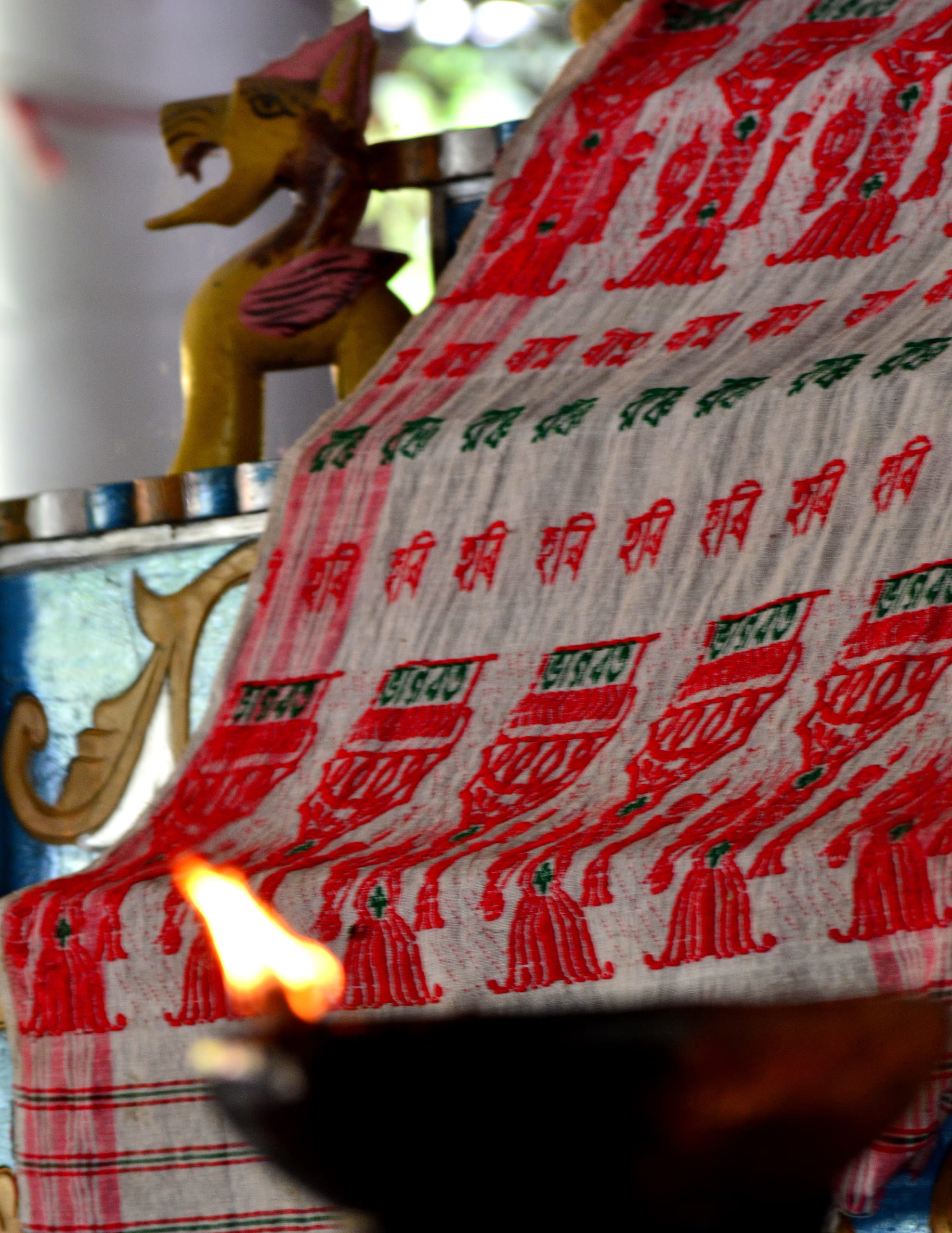
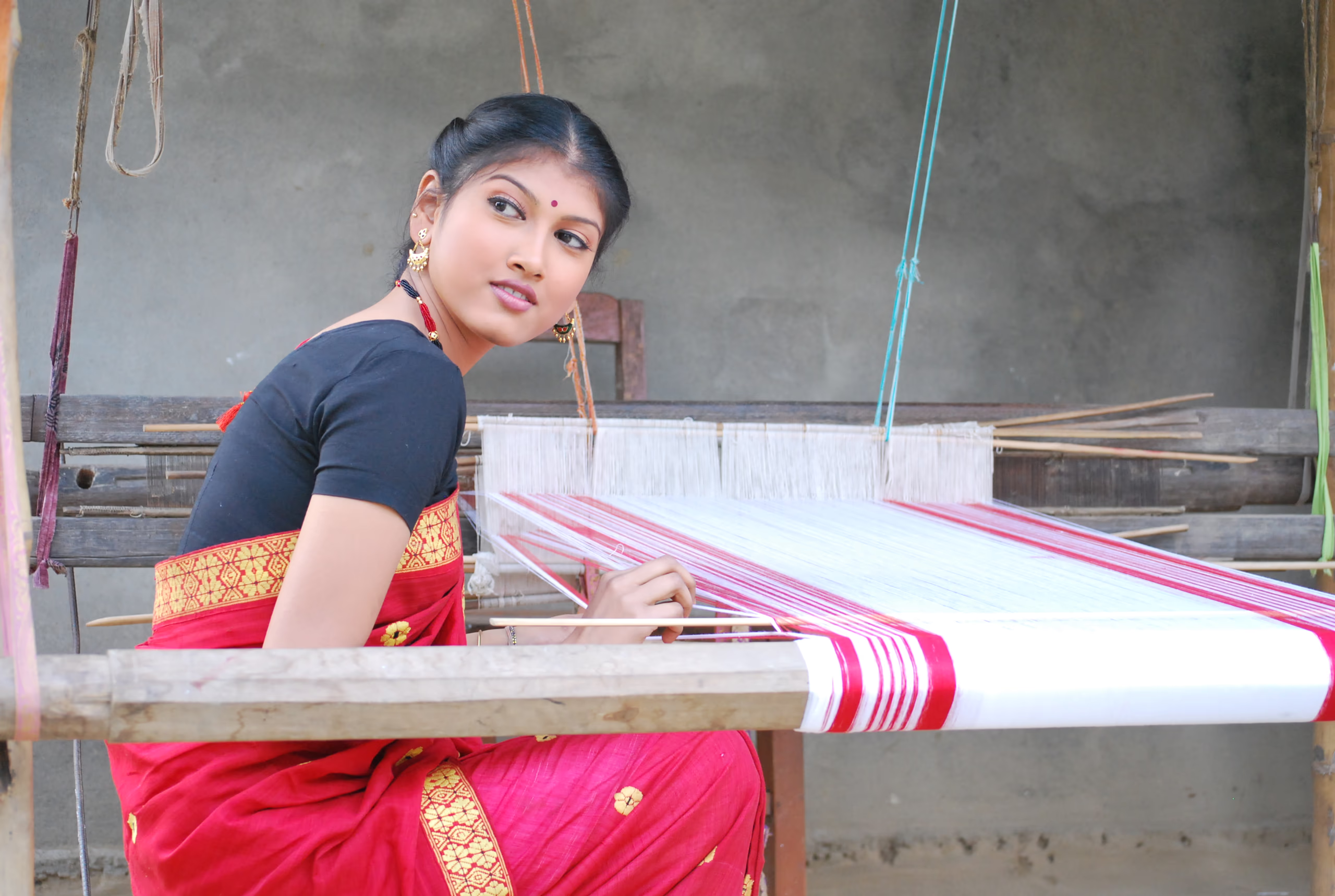
Beyond the plain red-and-white cloth stands the phulam gamosa, the flowered gamosa. In it the weaver fills the border, and sometimes the whole field, with woven motifs: the flowers, creepers, birds and geometric patterns of Assamese design. This is the gamosa of the great occasion. It is the one given to the most honoured guest and displayed at the most formal welcome. It is the everyday towel raised by the loom into a work of decorative art. The common cloth is cotton, but the gamosa of the highest occasion is sometimes woven in pat, the golden-white mulberry silk of Assam. The weaving has always been a household craft. It is worked by women at the loom set beneath the house across the valley. It is part of the same domestic textile tradition that produced Assam's silks. The phulam gamosa is among the clearest expressions of the weaver's skill. It is the material culture B.K. Barua surveyed for early Assam, carried into every home that owns a loom.
The emblem of a people
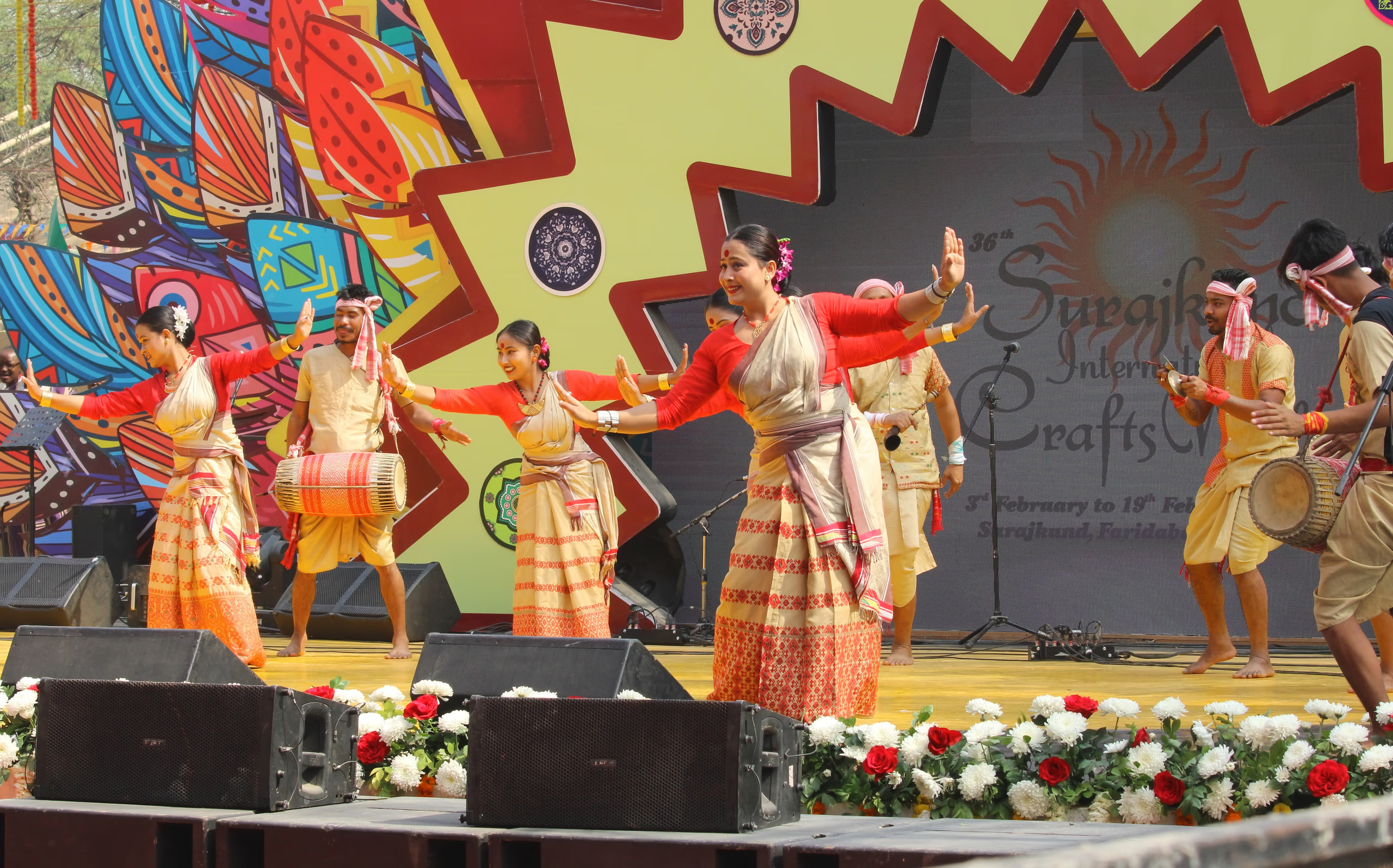
The cloth is old, and its beginnings are not precisely documented. It is sometimes traced to the Deori people of upper Assam, though the everyday gamosa is now woven across every community of the valley regardless of faith or ethnicity. More than any other object, the gamosa stands for Assam itself. It is tied around the waist or worn over the shoulder by the Bihu dancer as part of the festival's dress. It is draped on the busts of revered figures. And it is held aloft at gatherings, on stages and at protests as a banner of Assamese identity. It is the cloth a movement reaches for when it wants to say who it is. It travels easily into ceremony precisely because it begins in the ordinary. It is a thing every household owns and every Assamese recognises. So to raise it is to raise something shared. In that role it stands alongside the japi, the conical ceremonial hat. The two are the twin emblems by which Assam is known. The cloth and the hat together carry the look of the valley to the wider world.
A protected heritage
The gamosa today is utterly secure, woven into Assamese identity and present in every home, yet it faces the same modern pressure as the valley's other handlooms, undercut by the cheap power-loom and machine-printed imitations sold under its name to buyers who cannot tell the handwoven cloth from the copy. The Geographical Indication granted in 2022 answers exactly that pressure, marking the genuine handwoven gamosa and drawing a legal line around a cloth that the market had every incentive to counterfeit. The protection only recognises what Assam has always known, that the gamosa is not merely a textile but an instrument of the culture, a plain woven rectangle in which the everyday and the sacred are carried together, the surest emblem of the Assamese people.