Magh Bihu, also called Bhogali Bihu, is the Bihu of feasting. It is the harvest festival of Assam, kept in mid-January, when the granaries are full and the labour of the agricultural year is done. It falls at the winter-solstice turn that the rest of India keeps as Makar Sankranti or Pongal. But in Assam it takes its own distinctive shape. Of the three Bihus that mark the Assamese year, this is the one most purely given over to plenty. It is a festival of food and fire and community at the close of winter.
The harvest frame
Magh Bihu belongs to the agricultural cycle that underlies all three Bihus. It falls in the month of Magh, after the main sali rice harvest has been gathered and threshed. Its mood is one of abundance and release. It is the reward, in feasting, for the year's work in the fields. The three Bihus, taken together, track the whole rhythm of the rice year, and Magh Bihu marks its close. The spring Rongali Bihu celebrates sowing and renewal, and the autumn Kati Bihu is austere and anxious, kept in the lean weeks when the standing crop is not yet ripe and the granaries are low. The winter Magh Bihu is their opposite, the festival of the full barn.
Its whole character follows from that place in the farming year. Where Kati Bihu lights a single frugal lamp at the tulsi plant and prays over an unharvested field, Magh Bihu answers with fire, feasting and open plenty, once the same field has yielded its grain. The solstice turn it shares with the rest of the subcontinent gives it, too, the character of a harvest thanksgiving. Praphulla Datta Goswami's study of the Bihu songs reads the entire Bihu complex as an outgrowth of exactly this agrarian calendar, its rites and its music alike rooted in the cycle of the fields rather than in scripture.
Uruka, the night of the feast
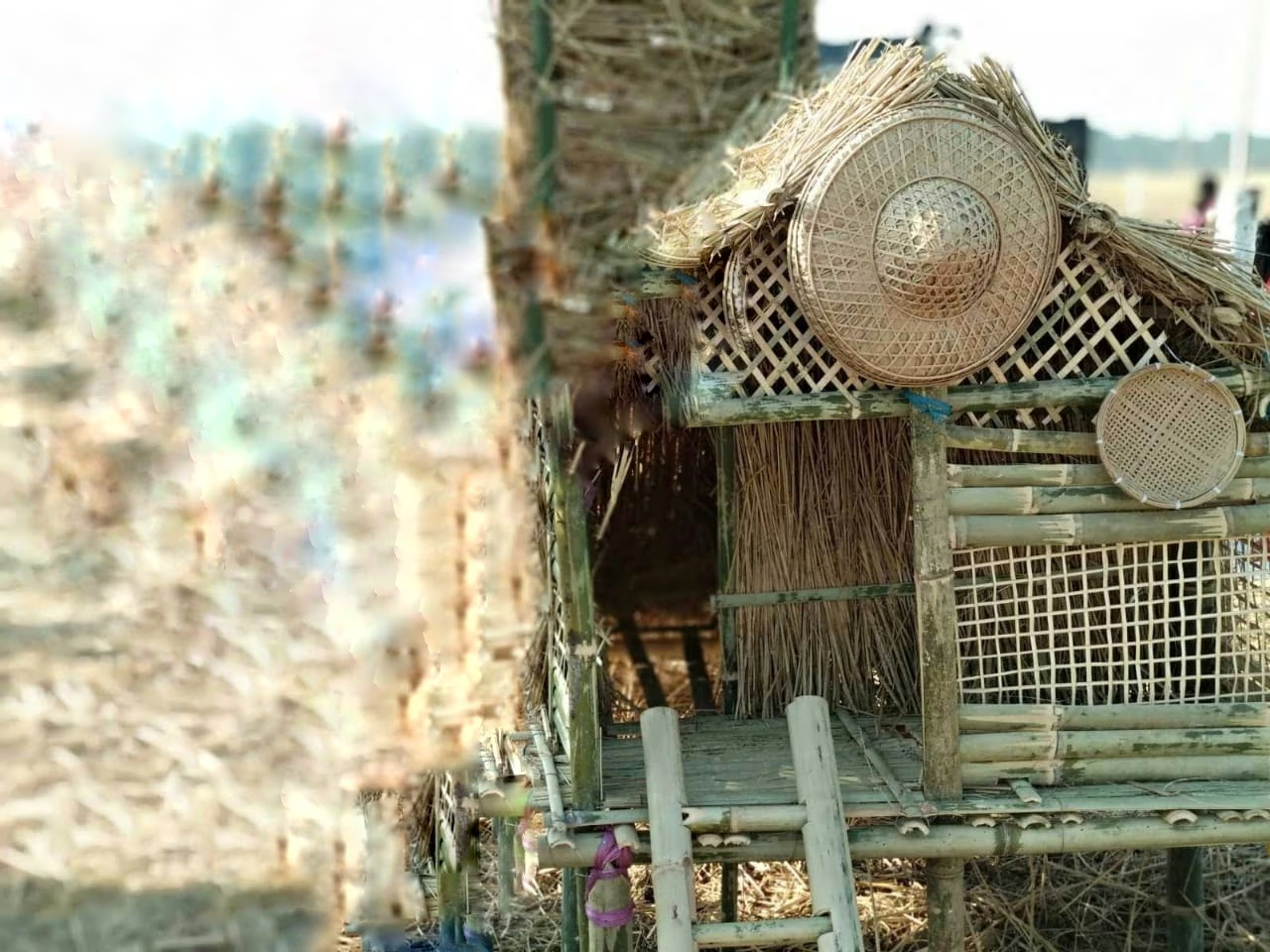
The festival opens on its eve, Uruka, the great night of eating. The name is generally traced to a Deori-Chutia word for the ending, the closing of the old cycle before the new. Through the day the women of the house prepare the rice-cakes and sweets. The men go out to the harvested fields to raise two temporary structures of straw and bamboo. The first is the bhelaghar, a makeshift hut in which the young keep watch and feast through the night. The second is the meji, a tall conical pyre of firewood and thatch built to be burned at dawn. The whole neighbourhood gathers for a communal feast, with fish netted from the winter ponds and meat. It runs late into the night around the fire.
The burning of the meji
At first light the community bathes and gathers at the meji, and the pyre is set alight. As it burns, people cast rice-cakes and betel-nuts into the flames and warm themselves at it. The rising smoke is understood as an offering carried up by the fire, and by older tradition a prayer to the ancestral gods. The word meji itself is generally traced to the Tibeto-Burman substratum of the valley’s culture, in keeping with the festival’s roots in the region’s pre-Aryan agrarian rites. When the meji has fallen, the half-burnt bamboo is carried out and scattered among the fields and fruit trees. It serves as a charm for the fertility of the coming year, so that the fire which ends one harvest also blesses the next. It is a rite enacted at the field-pyre and the hearth rather than in any temple.
Games, and the foods of plenty
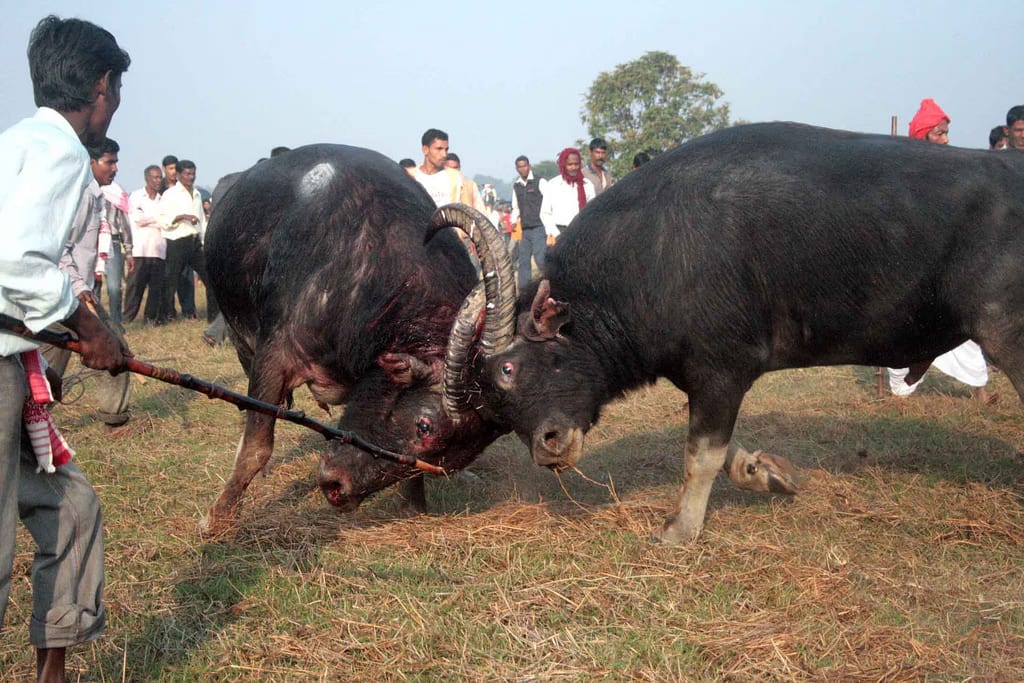
The day that follows is given to sport and eating. Older tradition, patronised in the valley since Ahom times, brought out the rural contests of the season. These were the buffalo-fight (moh-juj), cock-fights and egg-fights, and games such as the tekeli-bhonga, the breaking of a hung pot. The contests were village against village and household against household, staged in the open on ground the harvest had just cleared, and they turned the leisure of the slack season into public spectacle. The buffalo-fight in particular drew large crowds and long-running rivalries, and it continued at a few places into modern times before pressure over animal welfare curtailed it.
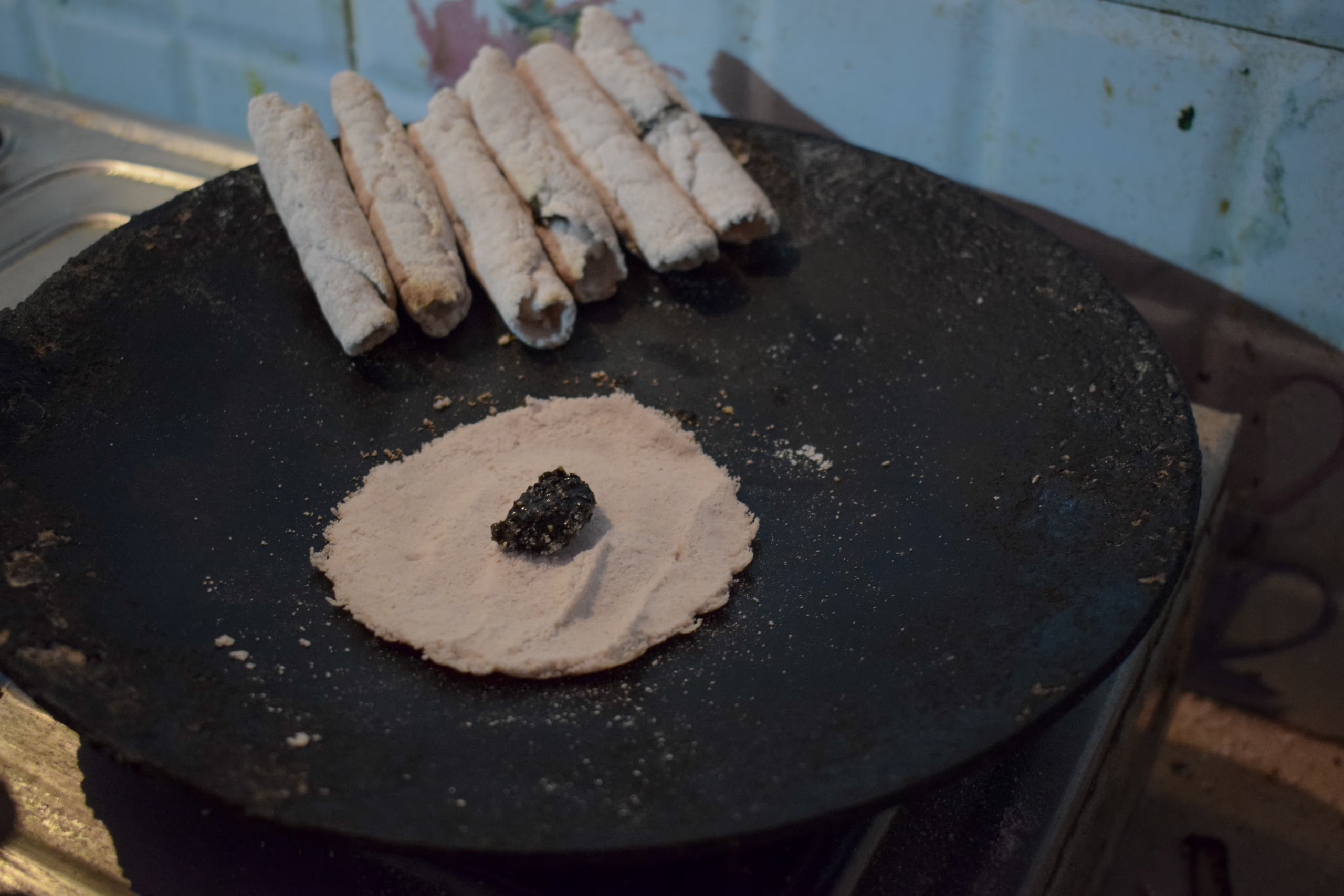
Everywhere, too, there is food, and it is the day's real centre. The rice-cakes are the pithas of the season, the til, ghila and sunga kinds, so named for the sesame filling, the shape, and the green bamboo tube in which the last is roasted over the fire. There are the laru sweets of sesame, coconut and molasses, and curd eaten with chira, the flattened rice of the fresh crop, and jaggery. Nearly all of it is built from the new harvest itself, the winter rice and the sesame and cane pressed after it, so that the eating is quite literally a tasting of what the fields have just given. It is all the edible sign of a year's plenty gathered in.
A festival of the land
Like the other Bihus, Magh Bihu is a festival of the land and the community more than of any creed. It is observed across the valley by Assamese-speakers of every religion, as a marker of the shared agricultural year, and it belongs to no temple, priesthood or single caste. What binds a village on Uruka night is the common harvest, not a common god. In this it keeps the older, pre-Aryan agrarian character that shows through the whole festival, a layer of folk rite that Hindu observance later overlaid but never replaced.
Its origins lie not in a founding myth but in the rhythm of the harvest itself. Unlike the great puranic festivals, Magh Bihu has no founder, no presiding deity and no charter legend to explain it, and where such stories attach to it at all, they are late and local grafts onto a practice that plainly came first. Its roots lie in the old human impulse to feast and light a fire when the work is done and the stores are full, an impulse the farming valley shared with harvest cultures far beyond it. The Uruka feast and the meji-fire are among the best-documented observances in the folklore record of the northeast, gathered and studied from the field rather than reconstructed from scripture, and it is that documentary weight, not any sacred text, that fixes what the festival is.